Abstract
Infection prevention and control (IPC) is a critical component of healthcare delivery, particularly for vulnerable populations at increased risk of healthcare-associated infections. Hospice patients may receive care in dedicated hospice facilities, long-term care facilities, or other healthcare environments, where infection prevention must coexist with broader therapeutic goals, including comfort, privacy, family involvement, and a home-like atmosphere. Although environmental design has been widely investigated in relation to IPC in healthcare settings, much of the existing evidence focuses on hospitals, with comparatively limited attention to hospice and long-term care environments. This study aimed to identify environmental design strategies that may enhance IPC in hospice facilities and examine their applicability within a hospice-specific therapeutic framework. A scoping literature review was conducted using PubMed and CINAHL for English-language studies published between 2015 and 2025. Following three rounds of screening, 30 studies were included. Data were extracted using standardized matrices documenting study characteristics, environmental and behavioral variables, outcomes, and key findings. Environmental findings were coded, compared, and analyzed using the environmental therapeutic goals and design criteria of the Hospice Environmental Assessment Protocol (HEAP) as an analytical framework. Three overarching themes and 14 subthemes emerged: ventilation and airborne infection control, including ventilation, filtration, airflow, and supplemental air disinfection; spatial planning, zoning, and circulation, including separation, shared spaces, circulation, access control, and room configuration; and environmental hygiene, surfaces, and cleaning, including high-touch surfaces, antimicrobial materials, environmental cleaning, disinfection technologies, and hand-hygiene-supportive design. The findings demonstrate that IPC in hospice environments extends beyond clinical safety and intersects with multiple therapeutic goals, including privacy, social interaction, autonomy, family accommodation, and staff support. Integrating IPC evidence with HEAP provides a framework for designing hospice environments that support infection prevention while preserving their therapeutic, residential, and family-centered qualities.
|
Published in
|
American Journal of Applied Psychology (Volume 15, Issue 5)
|
|
DOI
|
10.11648/j.ajap.20261505.11
|
|
Page(s)
|
168-186 |
|
Creative Commons
|

This is an Open Access article, distributed under the terms of the Creative Commons Attribution 4.0 International License (http://creativecommons.org/licenses/by/4.0/), which permits unrestricted use, distribution and reproduction in any medium or format, provided the original work is properly cited.
|
|
Copyright
|
Copyright © The Author(s), 2026. Published by Science Publishing Group
|
Keywords
Hospice Facilities, End-of-life Care, Infection Control, Infection Prevention, Environmental Design, Evidence-Based Design, Patient Safety, Healthcare-Associated Infections
1. Introduction
Infection prevention and control (IPC) is an essential component of healthcare delivery and patient safety. Healthcare-associated infections can affect patients across care settings; however, infection prevention is particularly important for individuals who are older, medically vulnerable, immunocompromised, or receiving complex care. Hospice patients often have advanced illnesses, multiple comorbidities, and substantial care needs and may receive care in dedicated hospice facilities, nursing homes, long-term care facilities, hospitals, or home-based settings. Consequently, infection prevention and management are important considerations throughout the continuum of hospice, palliative, and end-of-life care.
Infections present distinct challenges in hospice and palliative care because decisions concerning infection management must be balanced with the goals of comfort, symptom management, dignity, and quality of life. Earlier research examined symptomatic treatment of infections among patients with advanced cancer receiving hospice care
| [1] | Rosenberg JH, Albrecht JS, Fromme EK, Noble BN, McGregor JC, Comer AC, Furuno JP. Antimicrobial use for symptom management in patients receiving hospice and palliative care: A systematic review. J Palliat Med. 2013; 16(12): 1568–1574. https://doi.org/10.1089/jpm.2013.0276 |
[1]
, while subsequent studies have addressed antibiotic and antimicrobial use in hospice and palliative care
| [2] | Furuno JP, Noble BN, Fromme EK. Should we refrain from antibiotic use in hospice patients? Expert Review of Anti-Infective Therapy. 2016; 14(3): 277-280.
https://doi.org/10.1586/14787210.2016.1128823 |
| [3] | Shekhar AC. The use of antibiotics in hospice and palliative care settings. Journal of Hospice and Palliative Care. 2022; 25(1): 50. https://doi.org/10.14475/jhpc.2022.25.1.50 |
| [4] | Crowley PD, Siegel LR, Dickinson DT. Common antimicrobial treatment considerations for patients receiving comfort-focused care: What the hospice provider should know. Journal of Palliative Medicine. 2025; 28(8): 1006-1012.
https://doi.org/10.1089/jpm.2025.0040 |
[2-4]
. Infection management is also relevant in nursing homes and other long-term care settings where palliative and end-of-life care is provided. Stone (2017) identified the integration of infection management and palliative care in nursing homes as an understudied issue
, while Stone et al. (2019) and Tark et al. (2020) further examined the integration of infection management with palliative and end-of-life care in nursing homes
| [6] | Stone PW, Agarwal M, Ye F, Sorbero M, Miller SC, Dick AW. Integration of palliative care and infection management at the end of life in US nursing homes. Journal of Pain and Symptom Management. 2019; 58(3): 408-416.
https://doi.org/10.1016/j.jpainsymman.2019.06.001 |
| [7] | Tark A, Estrada LV, Tresgallo ME, Quigley DD, Stone PW, Agarwal M. Palliative care and infection management at end of life in nursing homes: A descriptive survey. Palliative Medicine. 2020; 3 4(5): 580-588. https://doi.org/10.1177/0269216320902672 |
[6, 7]
. Together, these studies demonstrate the importance and complexity of infection management for individuals approaching the end of life.
IPC in hospice and related care settings extends beyond treatment of an existing infection to include prevention, surveillance, preparedness, and everyday infection-control practices. Shang et al. (2014), in a systematic review of home health care, examined the prevalence of infections and patient-related risk factors, demonstrating the relevance of infection risk outside traditional hospital settings
| [8] | Shang J, Ma C, Poghosyan L, Dowding D, Stone PW. The prevalence of infections and patient risk factors in home health care: A systematic review. American Journal of Infection Control. 2014; 42(5): 479-484.
https://doi.org/10.1016/j.ajic.2013.12.018 |
[8]
. Adawee and Cole (2021) described the establishment of an evidence-based infection surveillance program for home care and hospice
| [9] | Adawee M, Cole S. Establishing an evidence-based infection surveillance program for home care and hospice: A large Midwest health system's experience. American Journal of Infection Control. 2021; 49(12): 1551-1553.
https://doi.org/10.1016/j.ajic.2021.08.007 |
[9]
, while Pogorzelska-Maziarz et al. (2020) examined home health staff perspectives on IPC
| [10] | Pogorzelska-Maziarz M, Chastain AM, Mangal S, Stone PW, Shang J. Home health staff perspectives on infection prevention and control: Implications for coronavirus disease 2019. Journal of the American Medical Directors Association. 2020; 21(12):1782-1790. https://doi.org/10.1016/j.jamda.2020.10.026. |
[10]
. More recent hospice-specific research has continued to emphasize the importance of IPC knowledge and practices among healthcare providers
| [11] | Kairbekovna KA, Aushatovna BM, Aushatovna AG, Zhaslanovna SD, Bakytbekovna AD, Toigombaeva VS. Assessment of knowledge and practice of infection prevention and control among nurses in a hospice in Almaty, Kazakhstan. Medicine, Science and Education. 2026;(1):104-116.
https://doi.org/10.24412/1609-8692-2026-1-104-116 |
[11]
. Collectively, this literature indicates that infection prevention requires attention across the diverse settings in which hospice and end-of-life care are delivered.
The COVID-19 pandemic further emphasized the vulnerability of hospice and palliative care services during infectious-disease outbreaks. Etkind et al. (2020) examined the role and response of palliative care and hospice services during epidemics and pandemics, highlighting the need for preparedness during infectious-disease emergencies
| [12] | Etkind SN, Bone AE, Lovell N, Cripps RL, Harding R, Higginson IJ, Sleeman KE. The role and response of palliative care and hospice services in epidemics and pandemics: A rapid review to inform practice during the COVID-19 pandemic. Journal of Pain and Symptom Management. 2020; 60(1): e31-e40. https://doi.org/10.1016/j.jpainsymman.2020.03.029 |
[12]
. Kader (2023) discussed the post-pandemic hospice environment and the need to reconsider hospice design in response to changing healthcare, social, and infection-control needs
| [13] | Kader S. Designing the post-pandemic hospice environment: “The last place.” In: (Re) Designing the Continuum of Care for Older Adults: The Future of Long-Term Care Settings. Cham: Springer International Publishing; 2023. p. 237-259.
https://doi.org/10.1007/978-3-031-20970-3_13 |
[13]
. Of particular relevance to environmental IPC, Feathers et al. (2022) reported an outbreak of SARS-CoV-2 in a hospice that was terminated following the implementation of enhanced aerosol infection-control measures
| [14] | Feathers L, Hinde T, Bale T, Hyde J, Bird PW, Holmes CW, Tang JW. Outbreak of SARS-CoV-2 at a hospice: Terminated after the implementation of enhanced aerosol infection control measures. Interface Focus. 2022; 12(2): 20210066.
https://doi.org/10.1098/rsfs.2021.0066 |
[14]
. This experience illustrates the potential importance of environmental and engineering interventions, in addition to clinical and behavioral measures, in controlling infection within hospice facilities.
The physical environment can play an important role in supporting infection prevention. Ventilation and airflow, spatial configuration, separation and zoning, circulation patterns, patient and family common areas, environmental surfaces and materials, hand-hygiene infrastructure, and the ability to effectively clean and disinfect spaces may influence opportunities for infection transmission. These considerations are particularly significant in hospice facilities because hospice environments must simultaneously function as healthcare settings and as therapeutic, supportive, and home-like environments for patients and their families. Emerging environmental research has emphasized the importance of examining hospice settings from this broader therapeutic perspective. For example, Mahmood et al. (2025) proposed an environmental assessment of hospice settings to examine how physical environments can support compassionate end-of-life care for older people experiencing homelessness
| [15] | Mahmood A, Chung S, Nanjiba N, Pandsheno S, Walsh J, Kader S, Canham S. Creating compassionate spaces for end-of-life care for older people experiencing homelessness: Protocol for an environmental assessment of hospice settings. JMIR Research Protocols. 2025; 14: e73356.
https://doi.org/10.2196/73356 |
[15]
.
The
Hospice Environmental Assessment Protocol (HEAP) provides a hospice-specific framework for understanding these relationships between the physical environment and therapeutic care
. Developed by Kader (2016), HEAP identifies 11 environmental therapeutic goals: (1) Continuity of Self, (2) Access to Nature, (3) Provide Privacy, (4) Support Social Interaction, (5) Ensure Safety and Security, (6) Provide Autonomy, (7) Regulate Sensory Stimulation, (8) Support Spiritual Care, (9) Provide Family Accommodation, (10) Support after Death, and (11) Support for Staff. These therapeutic goals recognize that the hospice environment must address not only clinical needs but also patients' physical, psychological, social, and emotional needs and the needs of family members and staff. Importantly,
Safety and Security explicitly incorporates infection-control considerations, including the selection of furniture, fittings, and finishes based on clinical and infection-control requirements, provision of an isolation room, handwashing sinks and sanitizers in patient rooms, and separate toilet and shower facilities for family members to reduce cross-contamination. Other HEAP goals also have potential relationships with IPC, including ventilation and access to fresh air, patient control of the immediate environment, spatial organization, privacy, social interaction, family accommodation, and staff support.
Integrating infection prevention with these therapeutic goals presents an important design challenge. Strategies that support infection control should not unnecessarily compromise the fundamental philosophy of hospice care. For example, separation and isolation may reduce opportunities for infection transmission but may also affect family presence and social interaction. Materials selected primarily for cleanability may contribute to an institutional appearance if their therapeutic and residential qualities are not considered. Similarly, ventilation and airflow requirements must be balanced with thermal comfort, patient autonomy, access to fresh air, and connection to nature. Therefore, environmental IPC strategies for hospice facilities require an approach that simultaneously considers infection prevention, safety, comfort, autonomy, social interaction, and family involvement.
Despite the recognized significance of infection management in hospice and palliative care, hospice-specific literature has predominantly addressed antimicrobial treatment, infection surveillance, staff knowledge and practices, and organizational responses to infectious diseases. Comparatively limited research has systematically examined how the physical and built environment can contribute to infection prevention in hospice facilities. At the same time, a growing body of evidence from hospitals, waiting areas, nursing homes, long-term care facilities, and other healthcare settings has investigated relationships between environmental design and infection transmission. Synthesizing this evidence and interpreting it within a hospice-specific therapeutic framework may provide a foundation for developing environmental IPC strategies appropriate for hospice care.
Therefore, this study reviews the literature on environmental and built-environment strategies associated with infection prevention and control in healthcare and long-term care settings and examines their relevance to hospice facilities. The environmental findings are further analyzed using the 11 therapeutic goals and associated design criteria of HEAP. By integrating current IPC evidence with a hospice-specific environmental framework, this study seeks to identify design strategies that can enhance infection prevention while maintaining the therapeutic qualities of hospice environments.
2. Research Questions
Infection prevention and control are important considerations in hospice, palliative, and end-of-life care, particularly because patients may be medically vulnerable and receive care across hospice, long-term care, nursing home, and home-care settings
| [5] | Stone PW. Integration of infection management and palliative care in nursing homes: An understudied issue. Research in Gerontological Nursing. 2017; 10(5): 199-204.
https://doi.org/10.3928/19404921-20170831-01 |
| [6] | Stone PW, Agarwal M, Ye F, Sorbero M, Miller SC, Dick AW. Integration of palliative care and infection management at the end of life in US nursing homes. Journal of Pain and Symptom Management. 2019; 58(3): 408-416.
https://doi.org/10.1016/j.jpainsymman.2019.06.001 |
| [7] | Tark A, Estrada LV, Tresgallo ME, Quigley DD, Stone PW, Agarwal M. Palliative care and infection management at end of life in nursing homes: A descriptive survey. Palliative Medicine. 2020; 3 4(5): 580-588. https://doi.org/10.1177/0269216320902672 |
| [9] | Adawee M, Cole S. Establishing an evidence-based infection surveillance program for home care and hospice: A large Midwest health system's experience. American Journal of Infection Control. 2021; 49(12): 1551-1553.
https://doi.org/10.1016/j.ajic.2021.08.007 |
[5-7, 9]
. The COVID-19 pandemic further highlighted the importance of infection-control preparedness in hospice and palliative care
| [12] | Etkind SN, Bone AE, Lovell N, Cripps RL, Harding R, Higginson IJ, Sleeman KE. The role and response of palliative care and hospice services in epidemics and pandemics: A rapid review to inform practice during the COVID-19 pandemic. Journal of Pain and Symptom Management. 2020; 60(1): e31-e40. https://doi.org/10.1016/j.jpainsymman.2020.03.029 |
[12]
, including the potential role of environmental and engineering measures in controlling infection transmission within hospice facilities
| [14] | Feathers L, Hinde T, Bale T, Hyde J, Bird PW, Holmes CW, Tang JW. Outbreak of SARS-CoV-2 at a hospice: Terminated after the implementation of enhanced aerosol infection control measures. Interface Focus. 2022; 12(2): 20210066.
https://doi.org/10.1098/rsfs.2021.0066 |
[14]
. At the same time, hospice environments are expected to support therapeutic goals such as comfort, privacy, autonomy, social interaction, family involvement, and a home-like atmosphere
| [13] | Kader S. Designing the post-pandemic hospice environment: “The last place.” In: (Re) Designing the Continuum of Care for Older Adults: The Future of Long-Term Care Settings. Cham: Springer International Publishing; 2023. p. 237-259.
https://doi.org/10.1007/978-3-031-20970-3_13 |
| [15] | Mahmood A, Chung S, Nanjiba N, Pandsheno S, Walsh J, Kader S, Canham S. Creating compassionate spaces for end-of-life care for older people experiencing homelessness: Protocol for an environmental assessment of hospice settings. JMIR Research Protocols. 2025; 14: e73356.
https://doi.org/10.2196/73356 |
| [16] | Kader S. Development of Hospice Environmental Assessment Protocol (HEAP): A post-occupancy evaluation tool. University of Kansas; 2016.
https://kuscholarworks.ku.edu/handle/1808/21798 |
[13, 15, 16]
. Therefore, this study aimed to identify environmental design strategies for infection prevention and control and examine their applicability to hospice environments. The following research questions guided the study:
1) What environmental and built-environment factors associated with infection prevention and control have been identified in healthcare and long-term care literature?
2) What major environmental design themes and strategies for infection prevention and control emerge from the reviewed literature?
3) How do the identified environmental design strategies relate to the 11 therapeutic goals and associated design criteria of the
Hospice Environmental Assessment Protocol (HEAP)
?
4) How can these environmental design strategies be applied to hospice facilities to support infection prevention while maintaining the 11 therapeutic goals hospice care?
3. Study Methods
This study employed a scoping review to identify and synthesize evidence concerning environmental and built-environment factors associated with infection prevention and control (IPC) in healthcare and long-term care settings and to examine their potential relevance to hospice environments. A scoping-review approach was selected because the literature encompasses heterogeneous settings and evidence types, including empirical studies, laboratory and experimental investigations, simulation and modeling studies, design-related studies, and evidence reviews. The review was conducted with reference to the JBI methodological guidance for scoping reviews and is reported in accordance with the Preferred Reporting Items for Systematic Reviews and Meta-Analyses Extension for Scoping Reviews (PRISMA-ScR).
3.1. Literature Search
A structured literature search was conducted using PubMed and CINAHL. The search covered literature published from January 1, 2015, through December 31, 2025. Only English-language, peer-reviewed publications were eligible for inclusion. Search terms were restricted to the article title field. This restriction was used to increase search specificity and identify publications in which IPC and the healthcare, long-term care, or built-environment context represented a central focus rather than an incidental reference. The search focused on healthcare environments and public or common areas, including patient care areas, waiting rooms, lobbies, corridors, elevators, and other shared spaces. Boolean search strategies combined concepts related to infection-control and healthcare settings.
Three complementary search concepts were applied in both databases: 1) infection control AND nursing home facility OR long-term care facility OR hospice care facility; 2) infection control AND built environment, and 3) infection control AND hospital facility OR healthcare facility. The first search retrieved 672 records from PubMed and 1,204 from CINAHL. The second retrieved 3 records from PubMed and 2 from CINAHL, and the third retrieved 302 records from PubMed and 492 from CINAHL. Across the three searches, 977 records were retrieved from PubMed and 1,698 from CINAHL, for a combined initial yield of 2,675 records (see
Table 1). Because the search concepts overlapped, the search results contained duplicate records within and across the database searches. A separate numerical record of duplicate removal was not maintained; duplicate records were identified during the screening process and were not advanced to subsequent screening stages. This procedure is reported transparently as a methodological limitation rather than retrospectively estimating the number of duplicates.
3.2. Inclusion and Exclusion Criteria
Studies were included if they: (i) examined infection prevention, infection transmission, healthcare-associated infections (HAIs), or related IPC outcomes; (ii) investigated characteristics or interventions associated with the physical or built environment; (iii) were conducted in hospice, long-term care, or other healthcare settings with environmental findings potentially applicable to hospice facilities; (iv) were published in peer-reviewed journals between 2015 and 2025; and (v) were published in English. Studies were excluded if they focused exclusively on clinical, pharmaceutical, policy, or behavioral infection-control interventions without an identifiable relationship to the physical environment; were conducted in settings with limited relevance to healthcare or long-term care environments; or did not provide findings that could inform environmental design strategies for infection prevention.
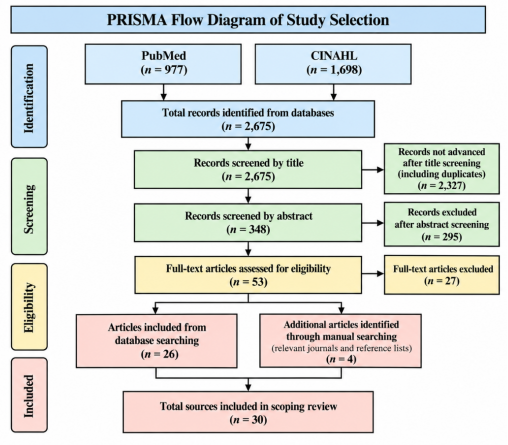
The literature selection involved three rounds of screening based on the inclusion and exclusion criteria. Screening was conducted sequentially at the title, abstract, and full-text levels. The database searches identified 2,675 records. Following title screening, 348 records were retained for abstract review; duplicate records encountered during screening were not advanced. Abstract screening excluded 295 records, leaving 53 articles for full-text assessment. Of these, 27 were excluded for not meeting the eligibility criteria or lacking sufficient environmental relevance, resulting in 26 eligible articles. An additional four articles were identified through manual searching of relevant journals and reference lists. Thus, 30 articles were included in the final scoping review (see
Figure 1)
| [17] | Bataille J, Brouqui P. Building an intelligent hospital to fight contagion. Clin Infect Dis. 2017; 65(Suppl 1): S4-S11.
https://doi.org/10.1093/cid/cix402 |
| [18] | Bloch N, Männer J, Gardiol C, Kohler P, Kuhn J, Münzer T, Schlegel M, Kuster SP, Flury D. Effective infection prevention and control measures in long-term care facilities in non-outbreak and outbreak settings: A systematic literature review. Antimicrob Resist Infect Control. 2023; 12(1): 113.
https://doi.org/10.1186/s13756-023-01318-9 |
| [19] | Daker WG, Panagioti M, Giles S, Blakeman T, Moore V, Hall A, Jones PP, Wright O, Shears B, Tyler N, Campbell S. Beyond the control of the care home: A meta-ethnography of qualitative studies of infection prevention and control in residential and nursing homes for older people. Health Expect. 2022; 25(5): 2095-2106. https://doi.org/10.1111/hex.13349 |
| [20] | de Araujo CM, Guariza-Filho O, Gonçalves FM, Basso IB, Schroder AGD, Cavalcante-Leão BL, Ravazzi GC, Zeigelboim BS, Stechman-Neto J, Santos RS. Front lines of the COVID-19 pandemic: What is the effectiveness of using personal protective equipment in health service environments? A systematic review. Int Arch Occup Environ Health. 2022; 95(1):7-24. https://doi.org/10.1007/s00420-021-01775-y |
| [21] | Estienney M, Daval-Frerot P, Aho-Glélé LS, Piroth L, Stabile P, Gerbet JY, Rouleau R, de Rougemont A, Belliot G. Use of a hydrogen peroxide nebulizer for viral disinfection of emergency ambulance and hospital waiting room. Food Environ Virol. 2022; 14(2): 217-221.
https://doi.org/10.1007/s12560-022-09519-y |
| [22] | Fritch WM, Agnew J, Rosman L, Cadorette MA, Barnett DJ. Application of the Haddon matrix to COVID-19 prevention and containment in nursing homes. J Am Geriatr Soc. 2021; 69(10):2708-2715. https://doi.org/10.1111/jgs.17358 |
| [23] | Gola M, Caggiano G, De Giglio O, Napoli C, Diella G, Carlucci M, Carpagnano LF, D'Alessandro D, Joppolo CM, Capolongo S, Montagna MT. SARS-CoV-2 indoor contamination: Considerations on anti-COVID-19 management of ventilation systems, and finishing materials in healthcare facilities. Ann Ig. 2021; 33(4):381-392.
https://doi.org/10.7416/ai.2020.2396 |
| [24] | Gontjes KJ, Gibson KE, Lansing B, Cassone M, Mody L. Contamination of common area and rehabilitation gym environment with multidrug-resistant organisms. J Am Geriatr Soc. 2020; 68(3):478-485. https://doi.org/10.1111/jgs.16284 |
| [25] | Grigg C, Palms D, Stone ND, Gualandi N, Bamberg W, Dumyati G, Harrison LH, Lynfield R, Nadle J, Petit S, Ray S, Schaffner W, Townes J, See I. Burden of invasive methicillin-resistant Staphylococcus aureus infections in nursing home residents. J Am Geriatr Soc. 2018; 66(8):1581-1586.
https://doi.org/10.1111/jgs.15451 |
| [26] | Hababou Y, Taleb A, Recoing A, Moreau F, Simon I, Muller de Schongor F, Gault E, Rameix-Welti MA. Molecular investigation of a RSV outbreak in a geriatric hospital. BMC Geriatr. 2021; 21(1): 1-8. https://doi.org/10.1186/s12877-021-02064-6 |
| [27] | Hernandez-Mejia G, Scheithauer S, Blaschke S, Kucheryava N, Schwarz K, Moellmann J, Tomori DV, Bartz A, Jaeger VK, Lange B, Kuhlmann A, Holzhausen J, Karch A. Architectural interventions to mitigate the spread of SARS-CoV-2 in emergency departments. J Hosp Infect. 2024; 151:1-10.
https://doi.org/10.1016/j.jhin.2024.05.019 |
| [28] | Herzig CTA, Stone PW, Castle N, Pogorzelska-Maziarz M, Larson EL, Dick AW. Infection prevention and control programs in US nursing homes: Results of a national survey. J Am Med Dir Assoc. 2016; 17(1):85-88.
https://doi.org/10.1016/j.jamda.2015.10.017 |
| [29] | Innes K, Jackson D, Plummer V, Elliott D. Care of patients in emergency department waiting rooms—An integrative review. J Adv Nurs. 2015; 71(12):2702-2714.
https://doi.org/10.1111/jan.12719 |
| [30] | Juan YK, Cheng YC, Perng YH, Castro-Lacouture D. Optimal decision model for sustainable hospital building renovation—A case study of a vacant school building converting into a community public hospital. Int J Environ Res Public Health. 2016; 13 (7): 630. https://doi.org/10.3390/ijerph13070630 |
| [31] | Kane DW, Finley C, Brown D. UV-C light and infection rate in a long term care ventilator unit. Can J Infect Control/Revue Canadienne de Prévention des Infections. 2018; 33(1):44. https://doi.org/10.3389/fbuil.2021.725624 |
| [32] | Kennedy B, Ashokan A, Lim CK, Lagana D, Juraja M, Shaw D. Designed for a pandemic: Mitigating the risk of SARS-CoV-2 transmission through hospital design and infrastructure. Infect Dis Health. 2024; 29(1): 25-31.
https://doi.org/10.1016/j.idh.2023.08.004 |
| [33] | Latour K, Catry B, Devleesschauwer B, Buntinx F, De Lepeleire J, Jans B. Healthcare-associated infections and antimicrobial use in Belgian nursing homes: Results of three point prevalence surveys between 2010 and 2016. Arch Public Health. 2022; 80(1):58.
https://doi.org/10.1186/s13690-022-00818-1 |
| [34] | Marcus EL, Yosef H, Borkow G, Caine Y, Sasson A, Moses AE. Reduction of health care-associated infection indicators by copper oxide-impregnated textiles: Crossover, double-blind controlled study in chronic ventilator-dependent patients. Am J Infect Control. 2017; 45(4):401-403.
https://doi.org/10.1016/j.ajic.2016.11.022. |
| [35] | Marsh RH, Chalmers KD, Checkett KA, Ansara J, Rimpel L, Edmond MC, Freni RW, Philbrook JK, Stanford K, Rouhani SA. Emergency department design in low- and middle-income settings: Lessons from a university hospital in Haiti. Ann Glob Health. 2020; 86(1):6.
https://doi.org/10.5334/aogh.2568 |
| [36] | McKinley L, Goedken CC, Balkenende E, Clore G, Hockett SS, Bartel R, Bradley S, Judd J, Lyons G, Rock C, Rubin M, Shaughnessy C, Reisinger HS, Perencevich E, Safdar N. Evaluation of daily environmental cleaning and disinfection practices in Veterans Affairs acute and long-term care facilities: A mixed methods study. Am J Infect Control. 2023; 51(2):205-213. https://doi.org/10.1016/j.ajic.2022.05.014 |
| [37] | Muller MP, MacDougall C, Lim M. Antimicrobial surfaces to prevent healthcare-associated infections: A systematic review. J Hosp Infect. 2016; 92(1): 7-13.
https://doi.org/10.1016/j.jhin.2015.09.008 |
| [38] | Nielsen CSR, Sanchez-Vargas R, Perez A. Clostridium difficile: Reducing infections using an evidence-based practice initiative. Clin J Oncol Nurs. 2019; 23(5):482-486.
https://doi.org/10.1188/19.CJON.482-487 |
| [39] | Olmsted RN. Prevention by design: Construction and renovation of health care facilities for patient safety and infection prevention. Infect Dis Clin North Am. 2016; 30(3): 713-728.
https://doi.org/10.1016/j.idc.2016.04.005 |
| [40] | Peerless K, Ullman E, Cummings KJ, Stoltey J, Epson E, Kim JJ, Siegel JD. Indoor air quality assessments in 10 long-term care facilities during the COVID-19 pandemic, California, 2021-2023. J Am Med Dir Assoc. 2024; 25(10): 105195.
https://doi.org/10.1016/j.jamda.2024.105195 |
| [41] | Poovelikunnel TT, Barakat A, O'Hara A, Humphreys HJ, Newmann V, Talento AF. Are positive-pressure ventilation lobby rooms effective for protective and source isolation? J Hosp Infect. 2020; 106(1): 53-56.
https://doi.org/10.1016/j.jhin.2020.05.043 |
| [42] | See I, Jackson KA, Hatfield KM, Paul P, Li R, Nadle J, Petit S, Ray SM, Harrison LH, Jeffrey L, Lynfield R, Bernu C, Dumyati G, Gellert A, Schaffner W, Markus T, Gokhale RH, Stone ND, Jacobs Slifka K. Characteristics of nursing homes with high rates of invasive methicillin-resistant Staphylococcus aureus infections. J Am Geriatr Soc. 2025; 73(3): 849-858.
https://doi.org/10.1111/jgs.19189 |
| [43] | Stockwell RE, Wood ME, Ballard E, Moore V, Wainwright CE, Bell SC. Current infection control practices used in Australian and New Zealand cystic fibrosis centers. BMC Pulm Med. 2020; 20(1): 16. https://doi.org/10.1186/s12890-020-1052-y |
| [44] | Tang K, Chen B. Resilient hospital design: From Crimean War to COVID-19. HERD. 2023; 16(4): 36-55.
https://doi.org/10.1177/19375867231174238 |
| [45] | Van Tiem JM, Friberg JE, Cunningham Goedken C, Pineles L, Schacht Reisinger H, Morgan DJ, Solimeo SL. Environmental service workers as potential designers of infection control policy in long-term care settings. Am J Infect Control. 2020; 48(4): 398-402. https://doi.org/10.1016/j.ajic.2020.01.014 |
| [46] | Wistrand C, Westerdahl E, Sundqvist AS. Effectiveness of reducing bacterial air contamination when covering sterile goods in the operating room setting: A systematic review and meta-analysis. J Hosp Infect. 2024; 145: 106-117.
https://doi.org/10.1016/j.jhin.2023.12.014 |
[17-46]
. The included studies represented healthcare environments from diverse geographic regions.
3.3. Results
A total of 30 studies were included in the review. The studies represented a range of healthcare environments, including hospitals, acute-care settings, emergency departments and waiting areas, nursing homes, long-term care facilities (LTCFs), geriatric care settings, and other patient and common areas. A substantial portion of the literature addressed nursing homes and long-term care environments, while other studies examined hospital environments with findings relevant to infection prevention in hospice settings. The studies represented diverse geographic contexts, including the United States, Canada, England, Germany, Sweden, Australia, New Zealand, Brazil, Taiwan, Haiti, and Israel.
The 30 studies employed diverse methodological approaches. Several studies synthesized existing evidence through systematic reviews, integrative reviews, meta-analyses, meta-ethnography, and other evidence reviews. Bloch et al. (2023), for example, reviewed 74 studies examining infection prevention and control measures in LTCFs
| [18] | Bloch N, Männer J, Gardiol C, Kohler P, Kuhn J, Münzer T, Schlegel M, Kuster SP, Flury D. Effective infection prevention and control measures in long-term care facilities in non-outbreak and outbreak settings: A systematic literature review. Antimicrob Resist Infect Control. 2023; 12(1): 113.
https://doi.org/10.1186/s13756-023-01318-9 |
[18]
, while Muller et al. (2016) systematically reviewed evidence on antimicrobial surfaces
. Daker et al. (2022) conducted a meta-ethnography examining IPC in care homes
| [19] | Daker WG, Panagioti M, Giles S, Blakeman T, Moore V, Hall A, Jones PP, Wright O, Shears B, Tyler N, Campbell S. Beyond the control of the care home: A meta-ethnography of qualitative studies of infection prevention and control in residential and nursing homes for older people. Health Expect. 2022; 25(5): 2095-2106. https://doi.org/10.1111/hex.13349 |
[19]
, and Wistrand et al. (2024) conducted a systematic review and meta-analysis addressing ventilation and air contamination
| [46] | Wistrand C, Westerdahl E, Sundqvist AS. Effectiveness of reducing bacterial air contamination when covering sterile goods in the operating room setting: A systematic review and meta-analysis. J Hosp Infect. 2024; 145: 106-117.
https://doi.org/10.1016/j.jhin.2023.12.014 |
[46]
. Other reviews examined PPE and aerosol transmission in closed healthcare environments, environmental safety in waiting areas, and COVID-19 prevention and containment strategies. The remaining literature included longitudinal, cross-sectional, observational, experimental, retrospective, qualitative, mixed-methods, modeling, and case studies, providing both empirical and design-oriented evidence concerning relationships between the healthcare environment and infection transmission.
Topically, a substantial group of studies investigated ventilation, indoor air quality, HVAC systems, filtration, airflow, and airborne transmission. Peerless et al. (2024) examined indoor-air-quality practices in LTCFs and identified inadequate outdoor-air introduction, insufficient filtration, and inconsistent use of portable air cleaners
| [40] | Peerless K, Ullman E, Cummings KJ, Stoltey J, Epson E, Kim JJ, Siegel JD. Indoor air quality assessments in 10 long-term care facilities during the COVID-19 pandemic, California, 2021-2023. J Am Med Dir Assoc. 2024; 25(10): 105195.
https://doi.org/10.1016/j.jamda.2024.105195 |
[40]
. Hernandez-Mejia et al. (2024) examined architectural interventions in an emergency-department waiting room, including ventilation, spacing, separation, and pathways
| [27] | Hernandez-Mejia G, Scheithauer S, Blaschke S, Kucheryava N, Schwarz K, Moellmann J, Tomori DV, Bartz A, Jaeger VK, Lange B, Kuhlmann A, Holzhausen J, Karch A. Architectural interventions to mitigate the spread of SARS-CoV-2 in emergency departments. J Hosp Infect. 2024; 151:1-10.
https://doi.org/10.1016/j.jhin.2024.05.019 |
[27]
. Kane et al. (2018) investigated continuous UV-C-treated air in a long-term care ventilator unit and reported lower HAI rates in rooms receiving the intervention
| [31] | Kane DW, Finley C, Brown D. UV-C light and infection rate in a long term care ventilator unit. Can J Infect Control/Revue Canadienne de Prévention des Infections. 2018; 33(1):44. https://doi.org/10.3389/fbuil.2021.725624 |
[31]
.
Another group of studies focused on spatial organization, waiting and common areas, separation, circulation, and patient or visitor movement. Waiting areas were frequently examined in relation to spacing, separation, pathways, ventilation, and patient and family use. Common spaces were also represented in the long-term care literature. For example, Gontjes et al. (2020) examined common areas and rehabilitation gyms across six nursing homes, including environmental contamination, furniture, high-touch surfaces, and interactions with patients and staff
| [24] | Gontjes KJ, Gibson KE, Lansing B, Cassone M, Mody L. Contamination of common area and rehabilitation gym environment with multidrug-resistant organisms. J Am Geriatr Soc. 2020; 68(3):478-485. https://doi.org/10.1111/jgs.16284 |
[24]
.
A third group of studies examined environmental hygiene, surface materials, and cleaning, including high-touch surfaces, furniture, antimicrobial surfaces and textiles, environmental contamination, cleaning practices, and environmental disinfection technologies. Some studies investigated antimicrobial materials and supplemental technologies, including copper-containing surfaces or textiles, UV-C, and hydrogen-peroxide disinfection. Estienney et al. (2022), for example, experimentally examined hydrogen-peroxide aerosol nebulization for surface decontamination in replicated waiting-room and ambulance environments
| [21] | Estienney M, Daval-Frerot P, Aho-Glélé LS, Piroth L, Stabile P, Gerbet JY, Rouleau R, de Rougemont A, Belliot G. Use of a hydrogen peroxide nebulizer for viral disinfection of emergency ambulance and hospital waiting room. Food Environ Virol. 2022; 14(2): 217-221.
https://doi.org/10.1007/s12560-022-09519-y |
[21]
.
4. Data Analysis
Data from the 30 included studies were extracted using a standardized data extraction matrix for comparison and analysis (Tables 2 and 3 in the Appendix).
Table 2 summarizes the characteristics of the literature, including country, setting, study design/sample, and IPC focus.
Table 3 presents the environmental/built-environment variables, user/behavioral variables, outcomes, and key findings identified in each study.
The extracted data were compared across studies to identify recurring patterns and relationships between the physical environment and infection prevention and control. Environmental findings were coded and grouped based on similarities in design characteristics and infection-control outcomes. Through this process, three overarching environmental themes and associated subthemes were identified.
The first theme, Ventilation and Airborne Infection Control, included four subthemes: ventilation and air exchange; HVAC, filtration, and indoor air quality; airflow direction and pressure control; and supplemental air-disinfection strategies. The second theme, Spatial Planning, Zoning, and Circulation, included five subthemes: separation and physical distancing; waiting and common-area design; circulation and patient/visitor flow; access control and zoning; and room configuration, occupancy, and flexibility. The third theme, Environmental Hygiene, Surfaces, and Cleaning, included five subthemes: high-touch surfaces and environmental contamination; materials and antimicrobial surfaces; environmental cleaning and disinfection; environmental cleaning technologies; and hand-hygiene-supportive environmental design.
The identified themes and subthemes were subsequently analyzed using the environmental therapeutic goals and associated design criteria of the
Hospice Environmental Assessment Protocol (HEAP)
as an analytical framework. HEAP includes 11 environmental therapeutic goals and associated design criteria for hospice environments, with specific infection-control considerations incorporated under
Safety and Security. This analysis was used to examine the relevance and potential application of the identified environmental IPC strategies to hospice environments.
4.1. Ventilation and Airborne Infection Control
Ventilation and airborne infection control emerged as a recurring environmental consideration across the reviewed literature. Studies examined natural and mechanical ventilation, air exchange, HVAC systems, filtration, indoor air quality, airflow direction and pressure relationships, and supplemental air-disinfection technologies.
4.1.1. Ventilation and Air Exchange
Ventilation and air exchange were among the most frequently addressed environmental strategies across the reviewed literature
| [17] | Bataille J, Brouqui P. Building an intelligent hospital to fight contagion. Clin Infect Dis. 2017; 65(Suppl 1): S4-S11.
https://doi.org/10.1093/cid/cix402 |
| [20] | de Araujo CM, Guariza-Filho O, Gonçalves FM, Basso IB, Schroder AGD, Cavalcante-Leão BL, Ravazzi GC, Zeigelboim BS, Stechman-Neto J, Santos RS. Front lines of the COVID-19 pandemic: What is the effectiveness of using personal protective equipment in health service environments? A systematic review. Int Arch Occup Environ Health. 2022; 95(1):7-24. https://doi.org/10.1007/s00420-021-01775-y |
| [23] | Gola M, Caggiano G, De Giglio O, Napoli C, Diella G, Carlucci M, Carpagnano LF, D'Alessandro D, Joppolo CM, Capolongo S, Montagna MT. SARS-CoV-2 indoor contamination: Considerations on anti-COVID-19 management of ventilation systems, and finishing materials in healthcare facilities. Ann Ig. 2021; 33(4):381-392.
https://doi.org/10.7416/ai.2020.2396 |
| [26] | Hababou Y, Taleb A, Recoing A, Moreau F, Simon I, Muller de Schongor F, Gault E, Rameix-Welti MA. Molecular investigation of a RSV outbreak in a geriatric hospital. BMC Geriatr. 2021; 21(1): 1-8. https://doi.org/10.1186/s12877-021-02064-6 |
| [27] | Hernandez-Mejia G, Scheithauer S, Blaschke S, Kucheryava N, Schwarz K, Moellmann J, Tomori DV, Bartz A, Jaeger VK, Lange B, Kuhlmann A, Holzhausen J, Karch A. Architectural interventions to mitigate the spread of SARS-CoV-2 in emergency departments. J Hosp Infect. 2024; 151:1-10.
https://doi.org/10.1016/j.jhin.2024.05.019 |
| [30] | Juan YK, Cheng YC, Perng YH, Castro-Lacouture D. Optimal decision model for sustainable hospital building renovation—A case study of a vacant school building converting into a community public hospital. Int J Environ Res Public Health. 2016; 13 (7): 630. https://doi.org/10.3390/ijerph13070630 |
| [32] | Kennedy B, Ashokan A, Lim CK, Lagana D, Juraja M, Shaw D. Designed for a pandemic: Mitigating the risk of SARS-CoV-2 transmission through hospital design and infrastructure. Infect Dis Health. 2024; 29(1): 25-31.
https://doi.org/10.1016/j.idh.2023.08.004 |
| [35] | Marsh RH, Chalmers KD, Checkett KA, Ansara J, Rimpel L, Edmond MC, Freni RW, Philbrook JK, Stanford K, Rouhani SA. Emergency department design in low- and middle-income settings: Lessons from a university hospital in Haiti. Ann Glob Health. 2020; 86(1):6.
https://doi.org/10.5334/aogh.2568 |
| [39] | Olmsted RN. Prevention by design: Construction and renovation of health care facilities for patient safety and infection prevention. Infect Dis Clin North Am. 2016; 30(3): 713-728.
https://doi.org/10.1016/j.idc.2016.04.005 |
| [40] | Peerless K, Ullman E, Cummings KJ, Stoltey J, Epson E, Kim JJ, Siegel JD. Indoor air quality assessments in 10 long-term care facilities during the COVID-19 pandemic, California, 2021-2023. J Am Med Dir Assoc. 2024; 25(10): 105195.
https://doi.org/10.1016/j.jamda.2024.105195 |
| [41] | Poovelikunnel TT, Barakat A, O'Hara A, Humphreys HJ, Newmann V, Talento AF. Are positive-pressure ventilation lobby rooms effective for protective and source isolation? J Hosp Infect. 2020; 106(1): 53-56.
https://doi.org/10.1016/j.jhin.2020.05.043 |
| [44] | Tang K, Chen B. Resilient hospital design: From Crimean War to COVID-19. HERD. 2023; 16(4): 36-55.
https://doi.org/10.1177/19375867231174238 |
| [45] | Van Tiem JM, Friberg JE, Cunningham Goedken C, Pineles L, Schacht Reisinger H, Morgan DJ, Solimeo SL. Environmental service workers as potential designers of infection control policy in long-term care settings. Am J Infect Control. 2020; 48(4): 398-402. https://doi.org/10.1016/j.ajic.2020.01.014 |
| [46] | Wistrand C, Westerdahl E, Sundqvist AS. Effectiveness of reducing bacterial air contamination when covering sterile goods in the operating room setting: A systematic review and meta-analysis. J Hosp Infect. 2024; 145: 106-117.
https://doi.org/10.1016/j.jhin.2023.12.014 |
[17, 20, 23, 26, 27, 30, 32, 35, 39-41, 44-46]
. Across these studies, adequate ventilation and air exchange were identified as important environmental considerations for controlling airborne transmission. Hernandez-Mejia et al. (2024) found that increased ventilation, together with greater distancing and separation, decreased modeled airborne transmission in an emergency department waiting room
| [27] | Hernandez-Mejia G, Scheithauer S, Blaschke S, Kucheryava N, Schwarz K, Moellmann J, Tomori DV, Bartz A, Jaeger VK, Lange B, Kuhlmann A, Holzhausen J, Karch A. Architectural interventions to mitigate the spread of SARS-CoV-2 in emergency departments. J Hosp Infect. 2024; 151:1-10.
https://doi.org/10.1016/j.jhin.2024.05.019 |
[27]
. Peerless et al. (2024) identified inadequate outdoor-air introduction and insufficient recirculated-air filtration in LTCFs
| [40] | Peerless K, Ullman E, Cummings KJ, Stoltey J, Epson E, Kim JJ, Siegel JD. Indoor air quality assessments in 10 long-term care facilities during the COVID-19 pandemic, California, 2021-2023. J Am Med Dir Assoc. 2024; 25(10): 105195.
https://doi.org/10.1016/j.jamda.2024.105195 |
[40]
.
Gola et al. (2020) also identified ventilation and HVAC systems among healthcare design considerations related to infection prevention
| [23] | Gola M, Caggiano G, De Giglio O, Napoli C, Diella G, Carlucci M, Carpagnano LF, D'Alessandro D, Joppolo CM, Capolongo S, Montagna MT. SARS-CoV-2 indoor contamination: Considerations on anti-COVID-19 management of ventilation systems, and finishing materials in healthcare facilities. Ann Ig. 2021; 33(4):381-392.
https://doi.org/10.7416/ai.2020.2396 |
[23].
4.1.2. HVAC, Filtration, and Indoor Air Quality
HVAC systems, filtration, and indoor air quality were specifically addressed across the reviewed literature
| [17] | Bataille J, Brouqui P. Building an intelligent hospital to fight contagion. Clin Infect Dis. 2017; 65(Suppl 1): S4-S11.
https://doi.org/10.1093/cid/cix402 |
| [23] | Gola M, Caggiano G, De Giglio O, Napoli C, Diella G, Carlucci M, Carpagnano LF, D'Alessandro D, Joppolo CM, Capolongo S, Montagna MT. SARS-CoV-2 indoor contamination: Considerations on anti-COVID-19 management of ventilation systems, and finishing materials in healthcare facilities. Ann Ig. 2021; 33(4):381-392.
https://doi.org/10.7416/ai.2020.2396 |
| [30] | Juan YK, Cheng YC, Perng YH, Castro-Lacouture D. Optimal decision model for sustainable hospital building renovation—A case study of a vacant school building converting into a community public hospital. Int J Environ Res Public Health. 2016; 13 (7): 630. https://doi.org/10.3390/ijerph13070630 |
| [40] | Peerless K, Ullman E, Cummings KJ, Stoltey J, Epson E, Kim JJ, Siegel JD. Indoor air quality assessments in 10 long-term care facilities during the COVID-19 pandemic, California, 2021-2023. J Am Med Dir Assoc. 2024; 25(10): 105195.
https://doi.org/10.1016/j.jamda.2024.105195 |
| [41] | Poovelikunnel TT, Barakat A, O'Hara A, Humphreys HJ, Newmann V, Talento AF. Are positive-pressure ventilation lobby rooms effective for protective and source isolation? J Hosp Infect. 2020; 106(1): 53-56.
https://doi.org/10.1016/j.jhin.2020.05.043 |
| [46] | Wistrand C, Westerdahl E, Sundqvist AS. Effectiveness of reducing bacterial air contamination when covering sterile goods in the operating room setting: A systematic review and meta-analysis. J Hosp Infect. 2024; 145: 106-117.
https://doi.org/10.1016/j.jhin.2023.12.014 |
[17, 23, 30, 40, 41, 46]
. These studies emphasized mechanical ventilation, filtration, outdoor-air supply, and indoor-air-quality management. Peerless et al. (2024) reported inadequate outdoor-air introduction, insufficient recirculated-air filtration, and inconsistent use of portable air cleaners among LTCFs
| [40] | Peerless K, Ullman E, Cummings KJ, Stoltey J, Epson E, Kim JJ, Siegel JD. Indoor air quality assessments in 10 long-term care facilities during the COVID-19 pandemic, California, 2021-2023. J Am Med Dir Assoc. 2024; 25(10): 105195.
https://doi.org/10.1016/j.jamda.2024.105195 |
[40]
. Juan et al. (2016) identified HVAC systems, increased ventilation, and improved air quality as environmental considerations for reducing infectious-disease transmission
| [30] | Juan YK, Cheng YC, Perng YH, Castro-Lacouture D. Optimal decision model for sustainable hospital building renovation—A case study of a vacant school building converting into a community public hospital. Int J Environ Res Public Health. 2016; 13 (7): 630. https://doi.org/10.3390/ijerph13070630 |
[30]
.
4.1.3. Airflow Direction and Pressure Control
Airflow direction and pressure relationships were examined across the reviewed literature
| [23] | Gola M, Caggiano G, De Giglio O, Napoli C, Diella G, Carlucci M, Carpagnano LF, D'Alessandro D, Joppolo CM, Capolongo S, Montagna MT. SARS-CoV-2 indoor contamination: Considerations on anti-COVID-19 management of ventilation systems, and finishing materials in healthcare facilities. Ann Ig. 2021; 33(4):381-392.
https://doi.org/10.7416/ai.2020.2396 |
| [32] | Kennedy B, Ashokan A, Lim CK, Lagana D, Juraja M, Shaw D. Designed for a pandemic: Mitigating the risk of SARS-CoV-2 transmission through hospital design and infrastructure. Infect Dis Health. 2024; 29(1): 25-31.
https://doi.org/10.1016/j.idh.2023.08.004 |
| [39] | Olmsted RN. Prevention by design: Construction and renovation of health care facilities for patient safety and infection prevention. Infect Dis Clin North Am. 2016; 30(3): 713-728.
https://doi.org/10.1016/j.idc.2016.04.005 |
| [41] | Poovelikunnel TT, Barakat A, O'Hara A, Humphreys HJ, Newmann V, Talento AF. Are positive-pressure ventilation lobby rooms effective for protective and source isolation? J Hosp Infect. 2020; 106(1): 53-56.
https://doi.org/10.1016/j.jhin.2020.05.043 |
[23, 32, 39, 41]
. These studies considered how ventilation design and pressure relationships influence the movement of airborne contaminants between patient rooms, doorways, corridors, and adjacent spaces. Poovelikunnel et al. (2020) examined positive- and neutral-pressure ventilation and reported that ventilation design and airflow direction could help prevent airborne pathogens from entering adjacent lobbies and corridors
| [41] | Poovelikunnel TT, Barakat A, O'Hara A, Humphreys HJ, Newmann V, Talento AF. Are positive-pressure ventilation lobby rooms effective for protective and source isolation? J Hosp Infect. 2020; 106(1): 53-56.
https://doi.org/10.1016/j.jhin.2020.05.043 |
[41]
.
4.1.4. Supplemental Air-Disinfection Strategies
Supplemental environmental disinfection technologies were investigated in the reviewed literature
| [21] | Estienney M, Daval-Frerot P, Aho-Glélé LS, Piroth L, Stabile P, Gerbet JY, Rouleau R, de Rougemont A, Belliot G. Use of a hydrogen peroxide nebulizer for viral disinfection of emergency ambulance and hospital waiting room. Food Environ Virol. 2022; 14(2): 217-221.
https://doi.org/10.1007/s12560-022-09519-y |
| [31] | Kane DW, Finley C, Brown D. UV-C light and infection rate in a long term care ventilator unit. Can J Infect Control/Revue Canadienne de Prévention des Infections. 2018; 33(1):44. https://doi.org/10.3389/fbuil.2021.725624 |
[21, 31]
. Kane et al.
| [31] | Kane DW, Finley C, Brown D. UV-C light and infection rate in a long term care ventilator unit. Can J Infect Control/Revue Canadienne de Prévention des Infections. 2018; 33(1):44. https://doi.org/10.3389/fbuil.2021.725624 |
[31]
examined continuous UV-C-treated air in a long-term care ventilator unit and reported lower HAI rates in rooms receiving UV-C treatment. Estienney et al.
| [21] | Estienney M, Daval-Frerot P, Aho-Glélé LS, Piroth L, Stabile P, Gerbet JY, Rouleau R, de Rougemont A, Belliot G. Use of a hydrogen peroxide nebulizer for viral disinfection of emergency ambulance and hospital waiting room. Food Environ Virol. 2022; 14(2): 217-221.
https://doi.org/10.1007/s12560-022-09519-y |
[21]
investigated hydrogen-peroxide aerosol nebulization and reported its potential for disinfecting small enclosed healthcare environments, including waiting rooms.
4.2. Spatial Planning, Zoning, and Circulation
The second theme concerned the relationship between spatial organization and infection transmission. The reviewed studies addressed separation and physical distancing, waiting and common areas, circulation patterns, patient and visitor movement, access control, zoning, and room configuration.
4.2.1. Separation and Physical Distancing
Separation and physical distancing were addressed across the reviewed literature
| [17] | Bataille J, Brouqui P. Building an intelligent hospital to fight contagion. Clin Infect Dis. 2017; 65(Suppl 1): S4-S11.
https://doi.org/10.1093/cid/cix402 |
| [20] | de Araujo CM, Guariza-Filho O, Gonçalves FM, Basso IB, Schroder AGD, Cavalcante-Leão BL, Ravazzi GC, Zeigelboim BS, Stechman-Neto J, Santos RS. Front lines of the COVID-19 pandemic: What is the effectiveness of using personal protective equipment in health service environments? A systematic review. Int Arch Occup Environ Health. 2022; 95(1):7-24. https://doi.org/10.1007/s00420-021-01775-y |
| [22] | Fritch WM, Agnew J, Rosman L, Cadorette MA, Barnett DJ. Application of the Haddon matrix to COVID-19 prevention and containment in nursing homes. J Am Geriatr Soc. 2021; 69(10):2708-2715. https://doi.org/10.1111/jgs.17358 |
| [27] | Hernandez-Mejia G, Scheithauer S, Blaschke S, Kucheryava N, Schwarz K, Moellmann J, Tomori DV, Bartz A, Jaeger VK, Lange B, Kuhlmann A, Holzhausen J, Karch A. Architectural interventions to mitigate the spread of SARS-CoV-2 in emergency departments. J Hosp Infect. 2024; 151:1-10.
https://doi.org/10.1016/j.jhin.2024.05.019 |
| [32] | Kennedy B, Ashokan A, Lim CK, Lagana D, Juraja M, Shaw D. Designed for a pandemic: Mitigating the risk of SARS-CoV-2 transmission through hospital design and infrastructure. Infect Dis Health. 2024; 29(1): 25-31.
https://doi.org/10.1016/j.idh.2023.08.004 |
| [35] | Marsh RH, Chalmers KD, Checkett KA, Ansara J, Rimpel L, Edmond MC, Freni RW, Philbrook JK, Stanford K, Rouhani SA. Emergency department design in low- and middle-income settings: Lessons from a university hospital in Haiti. Ann Glob Health. 2020; 86(1):6.
https://doi.org/10.5334/aogh.2568 |
| [43] | Stockwell RE, Wood ME, Ballard E, Moore V, Wainwright CE, Bell SC. Current infection control practices used in Australian and New Zealand cystic fibrosis centers. BMC Pulm Med. 2020; 20(1): 16. https://doi.org/10.1186/s12890-020-1052-y |
| [44] | Tang K, Chen B. Resilient hospital design: From Crimean War to COVID-19. HERD. 2023; 16(4): 36-55.
https://doi.org/10.1177/19375867231174238 |
[17, 20, 22, 27, 32, 35, 43, 44]
. The studies considered spacing and separation as mechanisms for limiting close contact and cross-infection, particularly in waiting and shared areas. De Araujo et al. identified ventilation and spacing in waiting rooms, together with PPE use, as measures associated with reduced aerosol transmission
| [20] | de Araujo CM, Guariza-Filho O, Gonçalves FM, Basso IB, Schroder AGD, Cavalcante-Leão BL, Ravazzi GC, Zeigelboim BS, Stechman-Neto J, Santos RS. Front lines of the COVID-19 pandemic: What is the effectiveness of using personal protective equipment in health service environments? A systematic review. Int Arch Occup Environ Health. 2022; 95(1):7-24. https://doi.org/10.1007/s00420-021-01775-y |
[20]
. Hernandez-Mejia et al. similarly found that greater distancing and separation, combined with increased ventilation, decreased modelled airborne transmission
| [27] | Hernandez-Mejia G, Scheithauer S, Blaschke S, Kucheryava N, Schwarz K, Moellmann J, Tomori DV, Bartz A, Jaeger VK, Lange B, Kuhlmann A, Holzhausen J, Karch A. Architectural interventions to mitigate the spread of SARS-CoV-2 in emergency departments. J Hosp Infect. 2024; 151:1-10.
https://doi.org/10.1016/j.jhin.2024.05.019 |
[27]
.
4.2.2. Waiting and Common-Area Design
Waiting and common areas were examined across the reviewed literature
| [19] | Daker WG, Panagioti M, Giles S, Blakeman T, Moore V, Hall A, Jones PP, Wright O, Shears B, Tyler N, Campbell S. Beyond the control of the care home: A meta-ethnography of qualitative studies of infection prevention and control in residential and nursing homes for older people. Health Expect. 2022; 25(5): 2095-2106. https://doi.org/10.1111/hex.13349 |
| [20] | de Araujo CM, Guariza-Filho O, Gonçalves FM, Basso IB, Schroder AGD, Cavalcante-Leão BL, Ravazzi GC, Zeigelboim BS, Stechman-Neto J, Santos RS. Front lines of the COVID-19 pandemic: What is the effectiveness of using personal protective equipment in health service environments? A systematic review. Int Arch Occup Environ Health. 2022; 95(1):7-24. https://doi.org/10.1007/s00420-021-01775-y |
| [21] | Estienney M, Daval-Frerot P, Aho-Glélé LS, Piroth L, Stabile P, Gerbet JY, Rouleau R, de Rougemont A, Belliot G. Use of a hydrogen peroxide nebulizer for viral disinfection of emergency ambulance and hospital waiting room. Food Environ Virol. 2022; 14(2): 217-221.
https://doi.org/10.1007/s12560-022-09519-y |
| [24] | Gontjes KJ, Gibson KE, Lansing B, Cassone M, Mody L. Contamination of common area and rehabilitation gym environment with multidrug-resistant organisms. J Am Geriatr Soc. 2020; 68(3):478-485. https://doi.org/10.1111/jgs.16284 |
| [27] | Hernandez-Mejia G, Scheithauer S, Blaschke S, Kucheryava N, Schwarz K, Moellmann J, Tomori DV, Bartz A, Jaeger VK, Lange B, Kuhlmann A, Holzhausen J, Karch A. Architectural interventions to mitigate the spread of SARS-CoV-2 in emergency departments. J Hosp Infect. 2024; 151:1-10.
https://doi.org/10.1016/j.jhin.2024.05.019 |
| [29] | Innes K, Jackson D, Plummer V, Elliott D. Care of patients in emergency department waiting rooms—An integrative review. J Adv Nurs. 2015; 71(12):2702-2714.
https://doi.org/10.1111/jan.12719 |
| [35] | Marsh RH, Chalmers KD, Checkett KA, Ansara J, Rimpel L, Edmond MC, Freni RW, Philbrook JK, Stanford K, Rouhani SA. Emergency department design in low- and middle-income settings: Lessons from a university hospital in Haiti. Ann Glob Health. 2020; 86(1):6.
https://doi.org/10.5334/aogh.2568 |
| [43] | Stockwell RE, Wood ME, Ballard E, Moore V, Wainwright CE, Bell SC. Current infection control practices used in Australian and New Zealand cystic fibrosis centers. BMC Pulm Med. 2020; 20(1): 16. https://doi.org/10.1186/s12890-020-1052-y |
| [45] | Van Tiem JM, Friberg JE, Cunningham Goedken C, Pineles L, Schacht Reisinger H, Morgan DJ, Solimeo SL. Environmental service workers as potential designers of infection control policy in long-term care settings. Am J Infect Control. 2020; 48(4): 398-402. https://doi.org/10.1016/j.ajic.2020.01.014 |
[19-21, 24, 27, 29, 35, 43, 45].
The literature identified waiting rooms, communal areas, rehabilitation gyms, and other shared spaces as environments requiring infection-control consideration. Innes et al. identified disease-transmission concerns associated with emergency department waiting areas. Gontjes et al. found that environmental surfaces contributed to the persistence and transmission of multidrug-resistant organisms in post-acute care facilities, with patient-used common areas more likely to be contaminated than nursing-used common areas
| [24] | Gontjes KJ, Gibson KE, Lansing B, Cassone M, Mody L. Contamination of common area and rehabilitation gym environment with multidrug-resistant organisms. J Am Geriatr Soc. 2020; 68(3):478-485. https://doi.org/10.1111/jgs.16284 |
[24]
.
4.2.3. Circulation and Patient/Visitor Flow
Circulation and movement through healthcare environments were addressed across the reviewed literature
| [17] | Bataille J, Brouqui P. Building an intelligent hospital to fight contagion. Clin Infect Dis. 2017; 65(Suppl 1): S4-S11.
https://doi.org/10.1093/cid/cix402 |
| [27] | Hernandez-Mejia G, Scheithauer S, Blaschke S, Kucheryava N, Schwarz K, Moellmann J, Tomori DV, Bartz A, Jaeger VK, Lange B, Kuhlmann A, Holzhausen J, Karch A. Architectural interventions to mitigate the spread of SARS-CoV-2 in emergency departments. J Hosp Infect. 2024; 151:1-10.
https://doi.org/10.1016/j.jhin.2024.05.019 |
| [32] | Kennedy B, Ashokan A, Lim CK, Lagana D, Juraja M, Shaw D. Designed for a pandemic: Mitigating the risk of SARS-CoV-2 transmission through hospital design and infrastructure. Infect Dis Health. 2024; 29(1): 25-31.
https://doi.org/10.1016/j.idh.2023.08.004 |
| [35] | Marsh RH, Chalmers KD, Checkett KA, Ansara J, Rimpel L, Edmond MC, Freni RW, Philbrook JK, Stanford K, Rouhani SA. Emergency department design in low- and middle-income settings: Lessons from a university hospital in Haiti. Ann Glob Health. 2020; 86(1):6.
https://doi.org/10.5334/aogh.2568 |
| [41] | Poovelikunnel TT, Barakat A, O'Hara A, Humphreys HJ, Newmann V, Talento AF. Are positive-pressure ventilation lobby rooms effective for protective and source isolation? J Hosp Infect. 2020; 106(1): 53-56.
https://doi.org/10.1016/j.jhin.2020.05.043 |
| [44] | Tang K, Chen B. Resilient hospital design: From Crimean War to COVID-19. HERD. 2023; 16(4): 36-55.
https://doi.org/10.1177/19375867231174238 |
[17, 27, 32, 35, 41, 44]
. Environmental factors included pathways, corridors, entrances, doorways, elevators, and movement between patient and public spaces. Bataille and Brouqui
considered visitor and corridor access control in relation to infectious-disease containment. Poovelikunnel et al.
| [41] | Poovelikunnel TT, Barakat A, O'Hara A, Humphreys HJ, Newmann V, Talento AF. Are positive-pressure ventilation lobby rooms effective for protective and source isolation? J Hosp Infect. 2020; 106(1): 53-56.
https://doi.org/10.1016/j.jhin.2020.05.043 |
[41]
examined the relationship between ventilation, doorways, lobbies, and corridors, demonstrating the interaction between circulation-space design and airborne infection control.
4.2.4. Access Control and Zoning
Access control and spatial zoning were addressed particularly across the reviewed literature
| [17] | Bataille J, Brouqui P. Building an intelligent hospital to fight contagion. Clin Infect Dis. 2017; 65(Suppl 1): S4-S11.
https://doi.org/10.1093/cid/cix402 |
| [22] | Fritch WM, Agnew J, Rosman L, Cadorette MA, Barnett DJ. Application of the Haddon matrix to COVID-19 prevention and containment in nursing homes. J Am Geriatr Soc. 2021; 69(10):2708-2715. https://doi.org/10.1111/jgs.17358 |
| [32] | Kennedy B, Ashokan A, Lim CK, Lagana D, Juraja M, Shaw D. Designed for a pandemic: Mitigating the risk of SARS-CoV-2 transmission through hospital design and infrastructure. Infect Dis Health. 2024; 29(1): 25-31.
https://doi.org/10.1016/j.idh.2023.08.004 |
[17, 22, 32]
. These studies considered visitor screening, isolation, controlled access, and management of movement during infectious-disease outbreaks. Bataille and Brouqui
described technology-supported visitor and corridor access control as part of infection containment, while Kennedy et al.
| [32] | Kennedy B, Ashokan A, Lim CK, Lagana D, Juraja M, Shaw D. Designed for a pandemic: Mitigating the risk of SARS-CoV-2 transmission through hospital design and infrastructure. Infect Dis Health. 2024; 29(1): 25-31.
https://doi.org/10.1016/j.idh.2023.08.004 |
[32]
examined hospital infrastructure and visitor-screening strategies associated with limiting nosocomial transmission.
4.2.5. Room Configuration, Occupancy, and Flexibility
Room configuration, occupancy, facility capacity, and care intensity were addressed across the reviewed literature
| [19] | Daker WG, Panagioti M, Giles S, Blakeman T, Moore V, Hall A, Jones PP, Wright O, Shears B, Tyler N, Campbell S. Beyond the control of the care home: A meta-ethnography of qualitative studies of infection prevention and control in residential and nursing homes for older people. Health Expect. 2022; 25(5): 2095-2106. https://doi.org/10.1111/hex.13349 |
| [22] | Fritch WM, Agnew J, Rosman L, Cadorette MA, Barnett DJ. Application of the Haddon matrix to COVID-19 prevention and containment in nursing homes. J Am Geriatr Soc. 2021; 69(10):2708-2715. https://doi.org/10.1111/jgs.17358 |
| [25] | Grigg C, Palms D, Stone ND, Gualandi N, Bamberg W, Dumyati G, Harrison LH, Lynfield R, Nadle J, Petit S, Ray S, Schaffner W, Townes J, See I. Burden of invasive methicillin-resistant Staphylococcus aureus infections in nursing home residents. J Am Geriatr Soc. 2018; 66(8):1581-1586.
https://doi.org/10.1111/jgs.15451 |
| [28] | Herzig CTA, Stone PW, Castle N, Pogorzelska-Maziarz M, Larson EL, Dick AW. Infection prevention and control programs in US nursing homes: Results of a national survey. J Am Med Dir Assoc. 2016; 17(1):85-88.
https://doi.org/10.1016/j.jamda.2015.10.017 |
| [36] | McKinley L, Goedken CC, Balkenende E, Clore G, Hockett SS, Bartel R, Bradley S, Judd J, Lyons G, Rock C, Rubin M, Shaughnessy C, Reisinger HS, Perencevich E, Safdar N. Evaluation of daily environmental cleaning and disinfection practices in Veterans Affairs acute and long-term care facilities: A mixed methods study. Am J Infect Control. 2023; 51(2):205-213. https://doi.org/10.1016/j.ajic.2022.05.014 |
| [42] | See I, Jackson KA, Hatfield KM, Paul P, Li R, Nadle J, Petit S, Ray SM, Harrison LH, Jeffrey L, Lynfield R, Bernu C, Dumyati G, Gellert A, Schaffner W, Markus T, Gokhale RH, Stone ND, Jacobs Slifka K. Characteristics of nursing homes with high rates of invasive methicillin-resistant Staphylococcus aureus infections. J Am Geriatr Soc. 2025; 73(3): 849-858.
https://doi.org/10.1111/jgs.19189 |
| [45] | Van Tiem JM, Friberg JE, Cunningham Goedken C, Pineles L, Schacht Reisinger H, Morgan DJ, Solimeo SL. Environmental service workers as potential designers of infection control policy in long-term care settings. Am J Infect Control. 2020; 48(4): 398-402. https://doi.org/10.1016/j.ajic.2020.01.014 |
[19, 22, 25, 28, 36, 42, 45]
. These studies examined patient or resident rooms, common spaces, available beds, room occupancy, and facility characteristics in relation to IPC
| [19] | Daker WG, Panagioti M, Giles S, Blakeman T, Moore V, Hall A, Jones PP, Wright O, Shears B, Tyler N, Campbell S. Beyond the control of the care home: A meta-ethnography of qualitative studies of infection prevention and control in residential and nursing homes for older people. Health Expect. 2022; 25(5): 2095-2106. https://doi.org/10.1111/hex.13349 |
| [22] | Fritch WM, Agnew J, Rosman L, Cadorette MA, Barnett DJ. Application of the Haddon matrix to COVID-19 prevention and containment in nursing homes. J Am Geriatr Soc. 2021; 69(10):2708-2715. https://doi.org/10.1111/jgs.17358 |
| [25] | Grigg C, Palms D, Stone ND, Gualandi N, Bamberg W, Dumyati G, Harrison LH, Lynfield R, Nadle J, Petit S, Ray S, Schaffner W, Townes J, See I. Burden of invasive methicillin-resistant Staphylococcus aureus infections in nursing home residents. J Am Geriatr Soc. 2018; 66(8):1581-1586.
https://doi.org/10.1111/jgs.15451 |
| [28] | Herzig CTA, Stone PW, Castle N, Pogorzelska-Maziarz M, Larson EL, Dick AW. Infection prevention and control programs in US nursing homes: Results of a national survey. J Am Med Dir Assoc. 2016; 17(1):85-88.
https://doi.org/10.1016/j.jamda.2015.10.017 |
| [36] | McKinley L, Goedken CC, Balkenende E, Clore G, Hockett SS, Bartel R, Bradley S, Judd J, Lyons G, Rock C, Rubin M, Shaughnessy C, Reisinger HS, Perencevich E, Safdar N. Evaluation of daily environmental cleaning and disinfection practices in Veterans Affairs acute and long-term care facilities: A mixed methods study. Am J Infect Control. 2023; 51(2):205-213. https://doi.org/10.1016/j.ajic.2022.05.014 |
| [42] | See I, Jackson KA, Hatfield KM, Paul P, Li R, Nadle J, Petit S, Ray SM, Harrison LH, Jeffrey L, Lynfield R, Bernu C, Dumyati G, Gellert A, Schaffner W, Markus T, Gokhale RH, Stone ND, Jacobs Slifka K. Characteristics of nursing homes with high rates of invasive methicillin-resistant Staphylococcus aureus infections. J Am Geriatr Soc. 2025; 73(3): 849-858.
https://doi.org/10.1111/jgs.19189 |
| [45] | Van Tiem JM, Friberg JE, Cunningham Goedken C, Pineles L, Schacht Reisinger H, Morgan DJ, Solimeo SL. Environmental service workers as potential designers of infection control policy in long-term care settings. Am J Infect Control. 2020; 48(4): 398-402. https://doi.org/10.1016/j.ajic.2020.01.014 |
[19, 22, 25, 28, 36, 42, 45]
. See et al.
| [42] | See I, Jackson KA, Hatfield KM, Paul P, Li R, Nadle J, Petit S, Ray SM, Harrison LH, Jeffrey L, Lynfield R, Bernu C, Dumyati G, Gellert A, Schaffner W, Markus T, Gokhale RH, Stone ND, Jacobs Slifka K. Characteristics of nursing homes with high rates of invasive methicillin-resistant Staphylococcus aureus infections. J Am Geriatr Soc. 2025; 73(3): 849-858.
https://doi.org/10.1111/jgs.19189 |
[42]
found that nursing homes with higher invasive MRSA rates served residents with greater clinical and functional care needs, demonstrating the importance of considering resident characteristics and care intensity when evaluating infection risk. Van Tiem et al.
| [45] | Van Tiem JM, Friberg JE, Cunningham Goedken C, Pineles L, Schacht Reisinger H, Morgan DJ, Solimeo SL. Environmental service workers as potential designers of infection control policy in long-term care settings. Am J Infect Control. 2020; 48(4): 398-402. https://doi.org/10.1016/j.ajic.2020.01.014 |
[45]
also identified resident-room layout and common-area design among environmental considerations relevant to IPC practices in LTCFs.
4.3. Environmental Hygiene, Surfaces, and Cleaning
The third major theme concerned environmental hygiene and the role of surfaces, materials, furnishings, and cleaning in infection prevention. Studies addressed high-touch surfaces, environmental contamination, antimicrobial materials, cleaning and disinfection practices, environmental disinfection technologies, and environmental support for hand hygiene.
4.3.1. High-Touch Surfaces and Environmental Contamination
High-touch surfaces and environmental contamination were addressed across the reviewed literature
| [18] | Bloch N, Männer J, Gardiol C, Kohler P, Kuhn J, Münzer T, Schlegel M, Kuster SP, Flury D. Effective infection prevention and control measures in long-term care facilities in non-outbreak and outbreak settings: A systematic literature review. Antimicrob Resist Infect Control. 2023; 12(1): 113.
https://doi.org/10.1186/s13756-023-01318-9 |
| [22] | Fritch WM, Agnew J, Rosman L, Cadorette MA, Barnett DJ. Application of the Haddon matrix to COVID-19 prevention and containment in nursing homes. J Am Geriatr Soc. 2021; 69(10):2708-2715. https://doi.org/10.1111/jgs.17358 |
| [24] | Gontjes KJ, Gibson KE, Lansing B, Cassone M, Mody L. Contamination of common area and rehabilitation gym environment with multidrug-resistant organisms. J Am Geriatr Soc. 2020; 68(3):478-485. https://doi.org/10.1111/jgs.16284 |
| [26] | Hababou Y, Taleb A, Recoing A, Moreau F, Simon I, Muller de Schongor F, Gault E, Rameix-Welti MA. Molecular investigation of a RSV outbreak in a geriatric hospital. BMC Geriatr. 2021; 21(1): 1-8. https://doi.org/10.1186/s12877-021-02064-6 |
| [36] | McKinley L, Goedken CC, Balkenende E, Clore G, Hockett SS, Bartel R, Bradley S, Judd J, Lyons G, Rock C, Rubin M, Shaughnessy C, Reisinger HS, Perencevich E, Safdar N. Evaluation of daily environmental cleaning and disinfection practices in Veterans Affairs acute and long-term care facilities: A mixed methods study. Am J Infect Control. 2023; 51(2):205-213. https://doi.org/10.1016/j.ajic.2022.05.014 |
| [38] | Nielsen CSR, Sanchez-Vargas R, Perez A. Clostridium difficile: Reducing infections using an evidence-based practice initiative. Clin J Oncol Nurs. 2019; 23(5):482-486.
https://doi.org/10.1188/19.CJON.482-487 |
[18, 22, 24, 26, 36, 38]
. The studies identified surfaces, furniture, shared objects, and frequently touched environmental features as potential reservoirs or pathways for pathogen transmission. Gontjes et al.
| [24] | Gontjes KJ, Gibson KE, Lansing B, Cassone M, Mody L. Contamination of common area and rehabilitation gym environment with multidrug-resistant organisms. J Am Geriatr Soc. 2020; 68(3):478-485. https://doi.org/10.1111/jgs.16284 |
[24]
found evidence of multidrug-resistant organism contamination on surfaces in common areas and rehabilitation gyms in nursing homes. Hababou et al.
| [26] | Hababou Y, Taleb A, Recoing A, Moreau F, Simon I, Muller de Schongor F, Gault E, Rameix-Welti MA. Molecular investigation of a RSV outbreak in a geriatric hospital. BMC Geriatr. 2021; 21(1): 1-8. https://doi.org/10.1186/s12877-021-02064-6 |
[26]
similarly considered infected surfaces and ventilation in examining an RSV outbreak in a geriatric healthcare environment.
4.3.2. Materials and Antimicrobial Surfaces
Surface and material characteristics were examined across the reviewed literature
| [19] | Daker WG, Panagioti M, Giles S, Blakeman T, Moore V, Hall A, Jones PP, Wright O, Shears B, Tyler N, Campbell S. Beyond the control of the care home: A meta-ethnography of qualitative studies of infection prevention and control in residential and nursing homes for older people. Health Expect. 2022; 25(5): 2095-2106. https://doi.org/10.1111/hex.13349 |
| [23] | Gola M, Caggiano G, De Giglio O, Napoli C, Diella G, Carlucci M, Carpagnano LF, D'Alessandro D, Joppolo CM, Capolongo S, Montagna MT. SARS-CoV-2 indoor contamination: Considerations on anti-COVID-19 management of ventilation systems, and finishing materials in healthcare facilities. Ann Ig. 2021; 33(4):381-392.
https://doi.org/10.7416/ai.2020.2396 |
| [34] | Marcus EL, Yosef H, Borkow G, Caine Y, Sasson A, Moses AE. Reduction of health care-associated infection indicators by copper oxide-impregnated textiles: Crossover, double-blind controlled study in chronic ventilator-dependent patients. Am J Infect Control. 2017; 45(4):401-403.
https://doi.org/10.1016/j.ajic.2016.11.022. |
| [37] | Muller MP, MacDougall C, Lim M. Antimicrobial surfaces to prevent healthcare-associated infections: A systematic review. J Hosp Infect. 2016; 92(1): 7-13.
https://doi.org/10.1016/j.jhin.2015.09.008 |
[19, 23, 34, 37]
. The studies addressed antimicrobial surfaces, copper-containing materials and textiles, and the relationship between material selection and microbial contamination. Daker et al.
| [19] | Daker WG, Panagioti M, Giles S, Blakeman T, Moore V, Hall A, Jones PP, Wright O, Shears B, Tyler N, Campbell S. Beyond the control of the care home: A meta-ethnography of qualitative studies of infection prevention and control in residential and nursing homes for older people. Health Expect. 2022; 25(5): 2095-2106. https://doi.org/10.1111/hex.13349 |
[19]
identified antimicrobial surfaces among environmental considerations in care homes. Gola et al.
| [23] | Gola M, Caggiano G, De Giglio O, Napoli C, Diella G, Carlucci M, Carpagnano LF, D'Alessandro D, Joppolo CM, Capolongo S, Montagna MT. SARS-CoV-2 indoor contamination: Considerations on anti-COVID-19 management of ventilation systems, and finishing materials in healthcare facilities. Ann Ig. 2021; 33(4):381-392.
https://doi.org/10.7416/ai.2020.2396 |
[23]
included surface materials along with ventilation and HVAC systems among healthcare design considerations. Overall, these studies indicate that material selection represents an environmental component of IPC, although the evidence and interventions varied across settings.
4.3.3. Environmental Cleaning and Disinfection
Environmental cleaning and disinfection were addressed across the reviewed literature
| [18] | Bloch N, Männer J, Gardiol C, Kohler P, Kuhn J, Münzer T, Schlegel M, Kuster SP, Flury D. Effective infection prevention and control measures in long-term care facilities in non-outbreak and outbreak settings: A systematic literature review. Antimicrob Resist Infect Control. 2023; 12(1): 113.
https://doi.org/10.1186/s13756-023-01318-9 |
| [21] | Estienney M, Daval-Frerot P, Aho-Glélé LS, Piroth L, Stabile P, Gerbet JY, Rouleau R, de Rougemont A, Belliot G. Use of a hydrogen peroxide nebulizer for viral disinfection of emergency ambulance and hospital waiting room. Food Environ Virol. 2022; 14(2): 217-221.
https://doi.org/10.1007/s12560-022-09519-y |
| [22] | Fritch WM, Agnew J, Rosman L, Cadorette MA, Barnett DJ. Application of the Haddon matrix to COVID-19 prevention and containment in nursing homes. J Am Geriatr Soc. 2021; 69(10):2708-2715. https://doi.org/10.1111/jgs.17358 |
| [23] | Gola M, Caggiano G, De Giglio O, Napoli C, Diella G, Carlucci M, Carpagnano LF, D'Alessandro D, Joppolo CM, Capolongo S, Montagna MT. SARS-CoV-2 indoor contamination: Considerations on anti-COVID-19 management of ventilation systems, and finishing materials in healthcare facilities. Ann Ig. 2021; 33(4):381-392.
https://doi.org/10.7416/ai.2020.2396 |
| [33] | Latour K, Catry B, Devleesschauwer B, Buntinx F, De Lepeleire J, Jans B. Healthcare-associated infections and antimicrobial use in Belgian nursing homes: Results of three point prevalence surveys between 2010 and 2016. Arch Public Health. 2022; 80(1):58.
https://doi.org/10.1186/s13690-022-00818-1 |
| [36] | McKinley L, Goedken CC, Balkenende E, Clore G, Hockett SS, Bartel R, Bradley S, Judd J, Lyons G, Rock C, Rubin M, Shaughnessy C, Reisinger HS, Perencevich E, Safdar N. Evaluation of daily environmental cleaning and disinfection practices in Veterans Affairs acute and long-term care facilities: A mixed methods study. Am J Infect Control. 2023; 51(2):205-213. https://doi.org/10.1016/j.ajic.2022.05.014 |
| [38] | Nielsen CSR, Sanchez-Vargas R, Perez A. Clostridium difficile: Reducing infections using an evidence-based practice initiative. Clin J Oncol Nurs. 2019; 23(5):482-486.
https://doi.org/10.1188/19.CJON.482-487 |
| [39] | Olmsted RN. Prevention by design: Construction and renovation of health care facilities for patient safety and infection prevention. Infect Dis Clin North Am. 2016; 30(3): 713-728.
https://doi.org/10.1016/j.idc.2016.04.005 |
| [43] | Stockwell RE, Wood ME, Ballard E, Moore V, Wainwright CE, Bell SC. Current infection control practices used in Australian and New Zealand cystic fibrosis centers. BMC Pulm Med. 2020; 20(1): 16. https://doi.org/10.1186/s12890-020-1052-y |
| [45] | Van Tiem JM, Friberg JE, Cunningham Goedken C, Pineles L, Schacht Reisinger H, Morgan DJ, Solimeo SL. Environmental service workers as potential designers of infection control policy in long-term care settings. Am J Infect Control. 2020; 48(4): 398-402. https://doi.org/10.1016/j.ajic.2020.01.014 |
[18, 21-23, 33, 36, 38, 39, 43, 45]
. These studies examined routine room cleaning, high-touch surface cleaning, environmental hygiene, decontamination, and the relationship between cleaning practices and the physical environment. Bloch et al.
| [18] | Bloch N, Männer J, Gardiol C, Kohler P, Kuhn J, Münzer T, Schlegel M, Kuster SP, Flury D. Effective infection prevention and control measures in long-term care facilities in non-outbreak and outbreak settings: A systematic literature review. Antimicrob Resist Infect Control. 2023; 12(1): 113.
https://doi.org/10.1186/s13756-023-01318-9 |
[18]
included cleaning protocols among IPC interventions evaluated in LTCFs. Nielsen et al.
| [38] | Nielsen CSR, Sanchez-Vargas R, Perez A. Clostridium difficile: Reducing infections using an evidence-based practice initiative. Clin J Oncol Nurs. 2019; 23(5):482-486.
https://doi.org/10.1188/19.CJON.482-487 |
[38]
emphasized cleaning of high-touch surfaces as an infection-prevention measure, while Van Tiem et al.
| [45] | Van Tiem JM, Friberg JE, Cunningham Goedken C, Pineles L, Schacht Reisinger H, Morgan DJ, Solimeo SL. Environmental service workers as potential designers of infection control policy in long-term care settings. Am J Infect Control. 2020; 48(4): 398-402. https://doi.org/10.1016/j.ajic.2020.01.014 |
[45]
demonstrated the importance of environmental-services workers and their knowledge of resident rooms and common spaces in LTCFs.
4.3.4. Environmental Cleaning Technologies
Specific environmental disinfection technologies were investigated primarily in the reviewed literature
| [21] | Estienney M, Daval-Frerot P, Aho-Glélé LS, Piroth L, Stabile P, Gerbet JY, Rouleau R, de Rougemont A, Belliot G. Use of a hydrogen peroxide nebulizer for viral disinfection of emergency ambulance and hospital waiting room. Food Environ Virol. 2022; 14(2): 217-221.
https://doi.org/10.1007/s12560-022-09519-y |
| [31] | Kane DW, Finley C, Brown D. UV-C light and infection rate in a long term care ventilator unit. Can J Infect Control/Revue Canadienne de Prévention des Infections. 2018; 33(1):44. https://doi.org/10.3389/fbuil.2021.725624 |
[21, 31]
. Estienney et al.
| [21] | Estienney M, Daval-Frerot P, Aho-Glélé LS, Piroth L, Stabile P, Gerbet JY, Rouleau R, de Rougemont A, Belliot G. Use of a hydrogen peroxide nebulizer for viral disinfection of emergency ambulance and hospital waiting room. Food Environ Virol. 2022; 14(2): 217-221.
https://doi.org/10.1007/s12560-022-09519-y |
[21]
evaluated hydrogen-peroxide aerosol nebulization for surface decontamination in replicated waiting-room and ambulance environments and found the method advantageous for disinfecting small enclosed areas. Kane et al.
| [31] | Kane DW, Finley C, Brown D. UV-C light and infection rate in a long term care ventilator unit. Can J Infect Control/Revue Canadienne de Prévention des Infections. 2018; 33(1):44. https://doi.org/10.3389/fbuil.2021.725624 |
[31]
examined continuous UV-C treatment and found lower HAI rates in treated patient rooms. These studies represent environmental technologies intended to supplement conventional infection-control measures.
4.3.5. Hand-Hygiene-Supportive Environmental Design
Hand hygiene and environmental support for hygiene practices were addressed across the reviewed literature
| [18] | Bloch N, Männer J, Gardiol C, Kohler P, Kuhn J, Münzer T, Schlegel M, Kuster SP, Flury D. Effective infection prevention and control measures in long-term care facilities in non-outbreak and outbreak settings: A systematic literature review. Antimicrob Resist Infect Control. 2023; 12(1): 113.
https://doi.org/10.1186/s13756-023-01318-9 |
| [19] | Daker WG, Panagioti M, Giles S, Blakeman T, Moore V, Hall A, Jones PP, Wright O, Shears B, Tyler N, Campbell S. Beyond the control of the care home: A meta-ethnography of qualitative studies of infection prevention and control in residential and nursing homes for older people. Health Expect. 2022; 25(5): 2095-2106. https://doi.org/10.1111/hex.13349 |
| [22] | Fritch WM, Agnew J, Rosman L, Cadorette MA, Barnett DJ. Application of the Haddon matrix to COVID-19 prevention and containment in nursing homes. J Am Geriatr Soc. 2021; 69(10):2708-2715. https://doi.org/10.1111/jgs.17358 |
| [28] | Herzig CTA, Stone PW, Castle N, Pogorzelska-Maziarz M, Larson EL, Dick AW. Infection prevention and control programs in US nursing homes: Results of a national survey. J Am Med Dir Assoc. 2016; 17(1):85-88.
https://doi.org/10.1016/j.jamda.2015.10.017 |
| [30] | Juan YK, Cheng YC, Perng YH, Castro-Lacouture D. Optimal decision model for sustainable hospital building renovation—A case study of a vacant school building converting into a community public hospital. Int J Environ Res Public Health. 2016; 13 (7): 630. https://doi.org/10.3390/ijerph13070630 |
[18, 19, 22, 28, 30]
. The literature addressed handwashing, sanitizer availability, hygiene stations, and access to hand-hygiene resources. Bloch et al.
| [18] | Bloch N, Männer J, Gardiol C, Kohler P, Kuhn J, Münzer T, Schlegel M, Kuster SP, Flury D. Effective infection prevention and control measures in long-term care facilities in non-outbreak and outbreak settings: A systematic literature review. Antimicrob Resist Infect Control. 2023; 12(1): 113.
https://doi.org/10.1186/s13756-023-01318-9 |
[18]
identified hand hygiene among IPC measures showing effectiveness in non-outbreak LTCF settings. Juan et al.
| [30] | Juan YK, Cheng YC, Perng YH, Castro-Lacouture D. Optimal decision model for sustainable hospital building renovation—A case study of a vacant school building converting into a community public hospital. Int J Environ Res Public Health. 2016; 13 (7): 630. https://doi.org/10.3390/ijerph13070630 |
[30]
included hygiene stations in waiting areas, together with HVAC and increased ventilation, among environmental strategies intended to reduce infectious-disease transmission.
5. Discussion
This scoping review identified three major environmental themes associated with infection prevention and control (IPC): (1) Ventilation and Airborne Infection Control, (2) Spatial Planning, Zoning, and Circulation, and (3) Environmental Hygiene, Surfaces, and Cleaning. Although much of the reviewed evidence originated from hospitals, long-term care facilities (LTCFs), nursing homes, and other healthcare environments, these findings have important implications for hospice settings. Hospice facilities share characteristics with both healthcare and long-term care environments; however, they also have a distinctive therapeutic philosophy emphasizing comfort, dignity, autonomy, family involvement, social interaction, and a home-like atmosphere. The findings therefore suggest that environmental IPC strategies should not simply be transferred from acute-care hospitals to hospice settings. Instead, they should be considered in relation to the therapeutic goals and design criteria of the
Hospice Environmental Assessment Protocol (HEAP)
.
5.1. Infection Prevention Within the HEAP Therapeutic Framework
HEAP provides an important framework for interpreting the environmental IPC findings because it considers the hospice environment from a holistic therapeutic perspective. Its 11 therapeutic goals are Continuity of Self, Access to Nature, Privacy, Social Interaction, Safety and Security, Autonomy, Sensory Stimulation, Spiritual Care, Family Accommodation, Support after Death, and Support for Staff. While infection prevention relates most directly to Safety and Security, the findings of this review demonstrate that IPC strategies intersect with several other therapeutic goals.
Under Safety and Security, HEAP specifically recommends selecting furniture, fittings, and finishes with clinical and infection-control requirements in mind, providing at least one isolation room, providing handwashing sinks and sanitizers in patient rooms, and providing separate toilet and shower facilities for family members to reduce cross-contamination. These criteria correspond directly with several findings of the present review. However, ventilation, spatial separation, circulation, common-area design, material selection, and environmental cleaning also interact with therapeutic objectives such as autonomy, privacy, social interaction, family accommodation, and staff support. Infection prevention in hospice should therefore be understood as a cross-cutting environmental consideration rather than an isolated safety requirement.
5.2. Ventilation and Airborne Infection Control
The first theme, Ventilation and Airborne Infection Control, included ventilation and air exchange; HVAC, filtration, and indoor air quality; airflow direction and pressure control; and supplemental air-disinfection strategies. The reviewed literature indicates that ventilation is an important environmental strategy for reducing airborne transmission. Studies in healthcare and long-term care settings identified outdoor-air supply, air exchange, filtration, HVAC performance, airflow direction, and pressure relationships as important considerations. Peerless et al., for example, identified inadequate outdoor-air introduction, insufficient recirculated-air filtration, and inconsistent portable air-cleaner use in LTCFs
| [40] | Peerless K, Ullman E, Cummings KJ, Stoltey J, Epson E, Kim JJ, Siegel JD. Indoor air quality assessments in 10 long-term care facilities during the COVID-19 pandemic, California, 2021-2023. J Am Med Dir Assoc. 2024; 25(10): 105195.
https://doi.org/10.1016/j.jamda.2024.105195 |
[40]
. Poovelikunnel et al. demonstrated the importance of airflow direction in controlling the movement of airborne pathogens between rooms and adjoining circulation spaces
| [41] | Poovelikunnel TT, Barakat A, O'Hara A, Humphreys HJ, Newmann V, Talento AF. Are positive-pressure ventilation lobby rooms effective for protective and source isolation? J Hosp Infect. 2020; 106(1): 53-56.
https://doi.org/10.1016/j.jhin.2020.05.043 |
[41]
.
These findings are particularly relevant to hospice environments in light of hospice-specific evidence. Feathers et al. (2022) reported that a SARS-CoV-2 outbreak in a hospice was terminated following implementation of enhanced aerosol infection-control measures
| [14] | Feathers L, Hinde T, Bale T, Hyde J, Bird PW, Holmes CW, Tang JW. Outbreak of SARS-CoV-2 at a hospice: Terminated after the implementation of enhanced aerosol infection control measures. Interface Focus. 2022; 12(2): 20210066.
https://doi.org/10.1098/rsfs.2021.0066 |
[14]
. Kader (2023) similarly emphasized the need to reconsider the hospice environment in response to lessons from the COVID-19 pandemic
| [13] | Kader S. Designing the post-pandemic hospice environment: “The last place.” In: (Re) Designing the Continuum of Care for Older Adults: The Future of Long-Term Care Settings. Cham: Springer International Publishing; 2023. p. 237-259.
https://doi.org/10.1007/978-3-031-20970-3_13 |
[13]
. Together, this evidence suggests that airborne infection control should be incorporated more explicitly into hospice environmental planning.
Ventilation also illustrates how IPC can intersect with multiple HEAP therapeutic goals. Access to Nature encourages access to fresh air through operable windows or doors, while Provision of Autonomy supports patients' ability to control features of their immediate environment, including windows, airflow, and temperature. Regulate Stimulation also addresses adequate fresh-air circulation through HVAC systems. Therefore, hospice ventilation design should balance infection-control performance with patient comfort, environmental control, access to fresh air, acoustic conditions, and connection to nature. Where clinically appropriate, mechanical ventilation, filtration, and controlled airflow can complement rather than replace these therapeutic qualities.
5.3. Spatial Planning, Zoning, and Circulation
The second theme, Spatial Planning, Zoning, and Circulation, included separation and physical distancing; waiting and common-area design; circulation and patient/visitor flow; access control and zoning; and room configuration, occupancy, and flexibility. The reviewed literature indicates that infection transmission is influenced not only by individual rooms but also by how people move through and share healthcare environments. Waiting areas, corridors, entrances, common areas, doorways, and other circulation spaces can create opportunities for contact and transmission.
This theme creates a particularly important challenge for hospice design because social interaction and family presence are central to end-of-life care. HEAP emphasizes the provision of multiple social spaces of different sizes and configurations rather than relying exclusively on one large central social area. The infection-control findings provide an additional rationale for this approach. Distributed, smaller-scale social and family spaces may support interaction while providing greater opportunities for separation, reduced crowding, and flexible occupancy when infection risk is elevated.
Common areas deserve particular attention. Evidence from nursing-home environments indicates that environmental surfaces in patient-used common areas may become reservoirs for multidrug-resistant organisms. In hospice settings, where patients and families may spend considerable time in lounges, family rooms, dining areas, gardens, and other shared spaces, IPC should therefore be considered in the planning, furnishing, ventilation, and maintenance of these environments.
Circulation and zoning also correspond with several HEAP goals. Continuity of Self encourages a residential rather than institutional layout and avoidance of long corridors. Family Accommodation, Support During Bereavement, and Support for Staff address family spaces, bereavement circulation, staff work areas, and staff/service movement. Thoughtful zoning may allow patient/family, staff/service, and other circulation patterns to be managed more effectively while reducing unnecessary movement through patient-care areas. Importantly, such zoning should remain flexible. During an outbreak, parts of a hospice may require temporary separation or controlled access, while under normal conditions the environment should remain welcoming and accessible.
5.4. Environmental Hygiene, Surfaces, and Cleaning
The third theme, Environmental Hygiene, Surfaces, and Cleaning, included high-touch surfaces and environmental contamination; materials and antimicrobial surfaces; environmental cleaning and disinfection; environmental cleaning technologies; and hand-hygiene-supportive environmental design. The reviewed studies demonstrate that environmental surfaces, furniture, shared objects, and common areas can contribute to pathogen persistence and transmission. Evidence from long-term care environments is particularly relevant because these settings, like hospices, seek to balance healthcare requirements with residential qualities.
This theme has a direct relationship with HEAP's Safety and Security goal, which recommends that furniture, fittings, and finishes be selected with both clinical and infection-control requirements in mind. However, HEAP's Continuity of Self also emphasizes familiar, residential, and non-institutional environmental qualities. These two objectives should not be considered contradictory. Instead, hospice material selection should balance cleanability, durability, compatibility with disinfectants, tactile quality, comfort, and residential appearance.
The findings also emphasize the importance of high-touch surfaces. Particular attention should be given to frequently handled elements such as door hardware, handrails, furniture surfaces, switches, bathroom fixtures, and shared equipment. Furniture and room configuration should facilitate effective cleaning and reduce inaccessible areas where contamination may persist, while still allowing patients to personalize their rooms and maintain a sense of home.
Hand hygiene provides another direct connection between environmental design and user behavior. HEAP recommends handwashing sinks and sanitizers in patient rooms and separate family toilet and shower facilities to reduce cross-contamination. The reviewed evidence reinforces the importance of accessible hand-hygiene infrastructure. However, simply providing a sink or sanitizer does not guarantee its use. Location, visibility, convenience, and relationship to care activities and circulation routes may influence behavior. Thus, environmental design can support IPC practices by making appropriate behaviors easier and more intuitive for staff, patients, families, and visitors.
5.5. Staff, Family, and User Behavior as Cross-Cutting Factors
Although the three themes focus primarily on physical environmental characteristics, the review also identified user and behavioral factors related to IPC, including staff cleaning practices, hand hygiene, PPE use, visitor management, and infection-control procedures. These factors were not treated as a separate environmental theme because they do not represent built-environment characteristics; however, they interact closely with environmental design.
For example, the effectiveness of environmental cleaning depends partly on whether room layouts and furnishings allow surfaces to be easily accessed. Hand-hygiene compliance can be influenced by the location and visibility of sinks and sanitizer dispensers. Visitor-management practices can be supported by entry configuration and zoning, while staff movement can be influenced by the location of work areas, supplies, and patient rooms. Van Tiem et al. demonstrated the value of environmental-services workers' perspectives in understanding how resident-room layout, common areas, ventilation, and cleaning practices interact in LTCFs.
This relationship is particularly important in hospice because families and visitors are not peripheral users of the environment; they are integral participants in end-of-life care. Environmental IPC strategies should therefore be understandable and accessible to family members without creating an overly clinical or restrictive atmosphere.
5.6. Balancing Infection Control with the Philosophy of Hospice Care
A central finding of this review is the need to balance infection prevention with the therapeutic philosophy of hospice care. Hospice facilities differ from many acute-care environments because the quality of the patient's remaining life, family presence, comfort, dignity, autonomy, and meaningful social interaction are fundamental goals of care. Kader (2023) emphasized the importance of reconsidering hospice design in the post-pandemic context, while recent environmental assessment research continues to examine how hospice environments can support compassionate end-of-life experiences
| [13] | Kader S. Designing the post-pandemic hospice environment: “The last place.” In: (Re) Designing the Continuum of Care for Older Adults: The Future of Long-Term Care Settings. Cham: Springer International Publishing; 2023. p. 237-259.
https://doi.org/10.1007/978-3-031-20970-3_13 |
| [15] | Mahmood A, Chung S, Nanjiba N, Pandsheno S, Walsh J, Kader S, Canham S. Creating compassionate spaces for end-of-life care for older people experiencing homelessness: Protocol for an environmental assessment of hospice settings. JMIR Research Protocols. 2025; 14: e73356.
https://doi.org/10.2196/73356 |
[13, 15]
.
Some IPC strategies may create potential tensions with these therapeutic goals. Isolation can protect patients from infection but may increase separation from family and social support. Physical distancing can reduce transmission opportunities but may interfere with social interaction. Highly clinical materials may facilitate cleaning but undermine residential character. Restrictive access control may improve outbreak management but conflict with family-centered care. The challenge for hospice design is therefore not simply to maximize infection control, but to identify environmental strategies that reduce infection risk while minimizing disruption to therapeutic experience.
The HEAP framework provides a useful mechanism for achieving this balance because it places Safety and Security alongside ten other therapeutic goals, rather than treating safety as the sole measure of environmental performance. Infection-control strategies can therefore be evaluated in relation to their potential effects on privacy, autonomy, social interaction, access to nature, family accommodation, bereavement, and staff support. This broader perspective may be particularly valuable when adapting evidence derived from hospitals and LTCFs to hospice facilities.
5.7. Implications for Hospice Settings Design
The synthesis of the scoping review findings with HEAP suggests several priorities for future hospice environmental design. Hospice facilities may benefit from effective ventilation and filtration; appropriate airflow management; flexible zoning and separation capabilities; smaller and distributed family and social spaces; clear and efficient circulation; cleanable but residentially appropriate materials and furnishings; careful attention to high-touch surfaces; accessible hand-hygiene facilities; and layouts that support effective environmental cleaning and staff workflows. Supplemental technologies such as UV-C or other environmental disinfection systems may also have potential applications in selected higher-risk spaces, although their appropriateness for hospice environments requires further investigation.
These strategies should not be interpreted as prescriptive design standards. Rather, they represent environmental considerations derived from the current evidence base that can be evaluated within the specific operational, clinical, cultural, and therapeutic context of individual hospice facilities. Importantly, because much of the evidence identified in this scoping review originated outside hospice settings, hospice-specific empirical research is needed to evaluate these strategies directly.
Overall, the findings suggest that infection prevention should be considered an integrated component of therapeutic hospice design rather than an additional clinical requirement imposed on the environment. Applying IPC evidence through the HEAP framework offers an approach for simultaneously considering infection risk and the broader environmental goals of hospice care. Such integration may help create hospice environments that are safer and more resilient to infectious disease while continuing to support comfort, dignity, autonomy, family presence, care, and a sense of home.
6. Conclusions
This scoping review identified three major environmental themes relevant to infection prevention and control in hospice facilities: Ventilation and Airborne Infection Control; Spatial Planning, Zoning, and Circulation; and Environmental Hygiene, Surfaces, and Cleaning. Integration of these findings with the HEAP therapeutic goals suggests that infection prevention should be considered as part of a holistic hospice environment that supports safety while maintaining all the therapeutic goals suggested by HEAP.
Because much of the existing evidence comes from hospitals, nursing homes, and long-term care facilities, more hospice-specific and patient-centered research is needed. Future studies should directly examine how environmental design influences infection risk and outcomes among hospice patients, particularly considering their unique physical conditions, vulnerability, mobility, length of stay, and end-of-life care needs. Research should also evaluate how infection-control strategies affect patient comfort, privacy, social interaction, and family presence. Empirical studies in hospice settings, including post-occupancy evaluations and intervention studies, are needed to validate the identified environmental strategies and develop evidence-based design recommendations.
7. Limitations
This literature review has several limitations and should be considered an initial effort to identify environmental design strategies related to infection prevention and control in hospice settings. The search was limited to studies published between 2015 and 2025, in the English language, and indexed in PubMed and CINAHL. Therefore, relevant studies published in other languages, outside the selected timeframe, or indexed in other databases may not have been included.
The review was also limited to peer-reviewed literature and did not include conference proceedings or other gray literature related to infection prevention and control or the built environment, which may contain relevant evidence. In addition, because limited empirical research specifically addresses infection prevention through environmental design in hospice facilities, the review included evidence from broader healthcare and long-term care settings. The applicability of these findings to hospice environments therefore requires further investigation.
Finally, data coding, thematic analysis, and interpretation were conducted by a single researcher using a code-recode procedure, which may introduce interpretive bias. Future research should validate the identified environmental themes and design strategies through empirical studies conducted specifically in hospice settings and examine their effectiveness in reducing infection risk while maintaining the therapeutic and residential qualities of hospice care.
Abbreviations
TG | Therapeutic Goals |
EBD | Evidence-Based Design |
IPC | Infection Prevention and Control |
HAI | Healthcare-Associated Infection |
LTCF | Long-Term Care Facility |
MDRO | Multidrug-Resistant Organism |
MRSA | Methicillin-Resistant Staphylococcus Aureus |
IAQ | Indoor Air Quality |
HVAC | Heating, Ventilation, And Air Conditioning |
PPE | Personal Protective Equipment |
Acknowledgments
The author would like to thank Ball State University and the University of Kansas for providing access to their library systems, which facilitated all the literature searches.
Author Contributions
Sharmin Kader: Conceptualization, Data curation, Formal Analysis, Investigation, Methodology, Resources, Validation, Visualization, Writing – original draft, review & editing
Data Availability Statement
The data is available from the corresponding author upon reasonable request. The data supporting the outcome of this research work has been reported in this manuscript.
Conflicts of Interest
The author declare no conflicts of interest.
Appendix
Table 1. Database Search Strategy and Number of Records Identified in PubMed and CINAHL.
Search | Search concepts | PubMed | CINAHL |
1 | Infection control AND nursing home facility OR long-term care facility OR hospice care facility | 672 | 1,204 |
2 | Infection control AND built environment | 3 | 2 |
3 | Infection control AND hospital facility OR healthcare facility | 302 | 492 |
| Total | 977 | 1,698 |
Figure 1. PRISMA-ScR Flow Diagram of Study Identification, Screening, Eligibility, and Inclusion.
Table 2. Study characteristics for investigating the environmental design to enhance infection prevention and Control.
# | Author, year | Country | Setting | Study design / sample | IPC focus |
1 | Bataille & Brouqui (2017) | France | University Hospital Institute | Clinical investigation; high-level preparedness setting | HAI prevention; hospital architecture; containment during mass influx/pandemic |
2 | Bloch et al. (2023) | Switzerland | Long-term care facilities (LTCFs) | Systematic literature review; 74 studies | Effectiveness of infection prevention and control measures in non-outbreak and outbreak settings |
3 | Daker et al. (2022) | England | Care homes for older people | Meta-ethnography; 15 records from 652 identified | Interpretive understanding of IPC in care homes after COVID-19 |
4 | de Araujo et al. (2022) | Brazil | Healthcare facilities; closed environments and waiting rooms | Systematic review; qualitative synthesis; 35 studies | PPE effectiveness and aerosol transmission in closed/waiting environments |
5 | Estienney et al. (2022) | France | Laboratory-replicated waiting room and ambulance cabin | Experimental study; MS2 and MNV models; virucidal testing | Surface decontamination and virucidal activity in small enclosed healthcare spaces |
6 | Fritch et al. (2021) | United States | Nursing homes / LTCFs | Evidence-based review using Haddon Matrix; 50 publications | COVID-19 prevention and containment in nursing homes |
7 | Gola et al. (2020) | Italy | Hospitals / emergency departments | Risk analysis using optical particle counter; institutions across Italy | HAI transmission; indoor air and mechanical ventilation |
8 | Gontjes et al. (2020) | United States (Michigan) | Six nursing homes; common areas and rehabilitation gyms | Descriptive study; 651 enrolled patients | MDRO burden and microorganism transfer in high-touch common-area and rehabilitation-gym surfaces |
9 | Grigg et al. (2018) | United States | Nursing homes / healthcare facilities in 33 U.S. counties | Retrospective epidemiologic analysis | Epidemiology and incidence of invasive MRSA in nursing-home residents |
10 | Hababou et al. (2021) | France (Paris) | Geriatric hospital / long-term care context | Longitudinal study; 19 patients sampled over 3 weeks | RSV outbreak origin and transmission dynamics |
11 | Hernandez-Mejia et al. (2024) | Germany | University Medical Center; emergency-department waiting room | Interdisciplinary modelling study; agent-based dynamic transmission model; 954 patients | Architectural interventions to mitigate respiratory-pathogen transmission |
12 | Herzig et al. (2016) | United States | Nursing homes | Cross-sectional survey; 900 nursing homes | Characteristics of nursing-home IPC programs and infection-control deficiencies |
13 | Innes et al. (2015) | Australia | Hospital emergency-department waiting areas | Integrative review; methodological critique and narrative synthesis; 6 papers | Environmental safety and disease-transmission concerns in waiting areas |
14 | Juan et al. (2016) | Taiwan | Simulated hospital conversion / renovated vacant school building | Case study; genetic algorithms and hybrid A* decision-support approach | Facility design, hygiene, air quality, and prevention of nosocomial infection |
15 | Kane et al. (2018) | United States | Hospital-based long-term care ventilator unit | Longitudinal study; 86 patients | Healthcare-associated infection rates and continuous UV-C exposure |
16 | Kennedy et al. (2024) | Australia | Hospital entrances, common areas, elevators, and acute-care units | Retrospective review; 264 observations/cases reported in source table | Hospital design and infrastructure for mitigating SARS-CoV-2 transmission |
17 | Latour et al. (2022) | Belgium | Nursing homes / LTCFs | Observational cross-sectional studies; 446 nursing homes (2010), 200 (2013), 257 (2016) | HAI prevalence, antimicrobial use, IPC, and antimicrobial stewardship |
18 | Marcus et al. (2017) | Israel | Hospital LTCF; chronic ventilator-dependent patient rooms | Crossover, double-blinded controlled study; 102 patients; 174 textile pieces | Reduction of HAI indicators using copper oxide-impregnated textiles |
19 | Marsh et al. (2020) | Haiti | Emergency department and waiting areas | Retrospective study; semi-structured interviews; sample 9 | Design features supporting efficient care and infection control |
20 | McKinley et al. (2023) | United States | Three Veterans Affairs acute and long-term care facilities | Convergent mixed methods; 62 room observations and 18 semi-structured interviews | Daily environmental cleaning and disinfection practices |
21 | Muller et al. (2016) | Canada | Healthcare facilities; patient rooms | Systematic review; 11 eligible studies | Effect of antimicrobial surfaces on HAI, ARO transmission, and microbial contamination |
22 | Nielsen et al. (2019) | United States | Medical-surgical units; acute care | Pilot observational study; sample 93 | Nosocomial infection prevention through cleaning of high-touch surfaces |
23 | Olmsted (2016) | United States | Acute-care hospital; acute and outpatient facilities | Retrospective study; risk analysis; sample 28 | Prevention of HAIs caused by opportunistic pathogens |
24 | Peerless et al. (2024) | United States (California) | 10 long-term care facilities | Observational study; 10 LTCFs | Indoor air quality (IAQ) practices for respiratory pathogen transmission |
25 | Poovelikunnel et al. (2020) | Ireland | Positive-pressure ventilation rooms, lobbies, and corridors | Comparison study; observation; sample 48 | Airborne-pathogen control using positive- versus neutral-pressure ventilation |
26 | See et al. (2025) | United States | 626 nursing homes | Mixed-methods/data analysis; 626 facilities | Facility characteristics associated with high nursing-home-onset invasive MRSA rates |
27 | Stockwell et al. (2020) | Australia and New Zealand | Hospitals and ambulatory clinics; cystic-fibrosis units | Quality-assurance survey; 124 units | Infection-control and contact-precaution practices in cystic-fibrosis centers |
28 | Tang & Chen (2023) | England | Simulated hospital environment using Building Information Modelling (BIM) | Case study/review; virtual built-hospital model | Evidence-based design and prevention of airborne/nosocomial transmission |
29 | Van Tiem et al. (2020) | United States (Iowa) | Community living centers within LTCFs | Qualitative study; 40 semi-structured interviews | Role and perspectives of environmental-services workers in IPC |
30 | Wistrand et al. (2024) | Sweden | Operating rooms | Systematic review and meta-analysis; 10 studies | Bacterial/air contamination and ventilation |
Table 3. Study variables and findings for environmental design to enhance infection prevention and Control.
# | Author, year | Environmental / built-environment variables | User / behavioral variables | Outcomes | Key findings |
1 | Bataille & Brouqui (2017) | Air filtration; separation; corridor/visitor access control; technology-supported containment | Isolation; cleaning; PPE; hand hygiene | Environmental / implementation outcomes | Technology-supported visitor and corridor access control, together with air filtration and separation, was used to limit infectious-disease transmission. |
2 | Bloch et al. (2023) | High-touch surfaces; environmental cleaning; availability/placement of hygiene resources | Hand hygiene, oral hygiene, mass testing, vaccination, education, cleaning protocols | Behavioral; organizational/structural; infection-related outcomes | Evidence quality was generally low. In non-outbreak settings, hand hygiene, oral hygiene, antimicrobial stewardship, and vaccination showed effectiveness; during outbreaks, IPC bundles and mass testing appeared promising. |
3 | Daker et al. (2022) | Antimicrobial surfaces; communal spaces | Hand hygiene; staff behavior and knowledge | Qualitative IPC practices and organizational factors | IPC was often perceived as outside the direct control of care homes, with limited staff ownership and stronger attention during outbreaks. |
4 | de Araujo et al. (2022) | Air exchange; ventilation; distancing/spacing in waiting rooms | PPE use and exposure | Qualitative infection-transmission outcomes | Ventilation and adequate spacing in waiting rooms, combined with mask/PPE use, were reported as effective measures for reducing contagious aerosol transmission. |
5 | Estienney et al. (2022) | Waiting-room ventilation; enclosed-space configuration; disinfection system | Contamination of inert surfaces | Environmental / virucidal outcomes | Aerosol nebulization with hydrogen peroxide was reported as advantageous for disinfecting small enclosed areas such as waiting rooms. |
6 | Fritch et al. (2021) | Hand-sanitizer placement; hand-hygiene supplies; high-touch surfaces; bed availability/density | Hand hygiene; exclusion of sick personnel; PPE; staffing; adherence to interventions | Qualitative/process and compliance outcomes | The Haddon Matrix provided a framework for nursing homes to organize strategies for preventing and containing COVID-19. |
7 | Gola et al. (2020) | Ventilation and HVAC systems; surface materials | Cleaning activities | Quantitative environmental outcomes | The study identified healthcare-design best practices related to ventilation, HVAC systems, and surface materials for infection prevention. |
8 | Gontjes et al. (2020) | Environmental contamination; high-touch surfaces; furniture; shared/common areas | Handwashing; touching surfaces, objects, and people | Quantitative microbial contamination/transfer | Environmental surfaces contributed to persistence and transmission of MDROs. Patient-used common areas were more likely to be contaminated than nursing-used common areas. |
9 | Grigg et al. (2018) | Available beds / facility capacity | Underlying medical conditions; wound and device care | Quantitative invasive MRSA incidence | Nursing-home-onset cases exceeded hospital-onset cases, particularly among residents with known MRSA risk factors, reinforcing IPC during wound and device care. |
10 | Hababou et al. (2021) | Infected surfaces; air ventilation | Droplet/contact precautions; confinement; masks; handwashing | Quantitative microbiological/environmental outcomes | Molecular investigation improved understanding of viral emergence and spread and supported more targeted disease-control approaches. |
11 | Hernandez-Mejia et al. (2024) | Waiting-room size; pathways; distance/spacing; separation; ventilation | Healthcare workers; staff training | Modelled airborne-transmission outcomes | Greater distancing, separation, and ventilation decreased modelled airborne transmission; combined architectural and staff-management interventions were recommended. |
12 | Herzig et al. (2016) | Airborne and surface transmission considerations | Vaccination; handwashing; symptom communication; training | Quantitative program/behavioral outcomes | Nursing homes generally reported IPC programs consistent with guidelines, but programs varied widely; facilities with less experience/training were less likely to support continuing education. |
13 | Innes et al. (2015) | Design of patient and family waiting areas | Waiting time / patient-care processes | Qualitative environmental outcomes | Emergency-department waiting areas were identified as environments with potential disease-transmission risk, underscoring the importance of waiting-area design. |
14 | Juan et al. (2016) | HVAC systems; ventilation; indoor air quality; hygiene-station provision; renovation design | Energy consumption; sustainability considerations | Built-environment / efficiency outcomes | The study proposed HVAC, increased ventilation, and hygiene stations in waiting areas as design measures to reduce infectious-disease transmission in converted healthcare facilities. |
15 | Kane et al. (2018) | Continuous/shielded UV-C light; room-level air treatment; ventilator environment | Antibiotic use; room cleaning; glove/gown compliance; isolation practices | Quantitative HAI rates | HAI rates were lower in rooms with UV-C treatment. Findings suggest continuous UV-C-treated air may reduce HAI and provide a nonstaff-dependent environmental intervention. |
16 | Kennedy et al. (2024) | Ventilation direction/control; hospital infrastructure; common-area design | Airborne-infection isolation; PPE training; visitor screening | Environmental infection-control outcomes | Visitor screening and ventilation direction/control were identified as important hospital design and infrastructure considerations for limiting nosocomial transmission. |
17 | Latour et al. (2022) | Environmental hygiene | Medical devices; care compliance; antimicrobial practices | Quantitative HAI and antimicrobial-use outcomes | IPC practices improved over time, but infection prevalence and antibiotic use did not decline significantly, indicating a need for stronger and more standardized IPC approaches. |
18 | Marcus et al. (2017) | Copper oxide-impregnated linens, patient clothing, and towels | Antibiotic use; care compliance; symptom reporting; ventilator care | Quantitative HAI indicators and antibiotic use | Copper oxide-impregnated textiles significantly reduced HAI indicators and antibiotic use. |
19 | Marsh et al. (2020) | Natural/roof ventilation; separation of waiting areas; patient flow; space flexibility | Accessibility; security | Qualitative design outcomes | Increased ventilation and separation of waiting areas were associated with safer conditions and reduced potential for airborne transmission among patients, families, and staff. |
20 | McKinley et al. (2023) | Contaminated surfaces and rooms; high-touch surfaces; private/semi-private rooms | Environmental-services cleaning behavior; patient presence/absence | Quantitative cleaning rates plus qualitative contextual findings | Daily cleaning rates of environmental-surface were low. Cleaning was more frequent for high-touch surfaces and when patients were absent, highlighting challenges when occupied rooms are cleaned. |
21 | Muller et al. (2016) | Antimicrobial surfaces; location of treated surfaces | Hand hygiene; protocol compliance | Quantitative microbial contamination/infection outcomes | Copper surfaces reduced microbial contamination in included studies, but overall evidence was limited and depended on the surface type and healthcare setting. |
22 | Nielsen et al. (2019) | High-touch surface materials and cleaning | Training of clinicians and environmental-services staff | Quantitative infection-control outcomes | The study emphasized cleaning high-touch surface areas as an important measure for preventing transmission of nosocomial infections. |
23 | Olmsted (2016) | Construction/design; ventilation; environmental decontamination | Risk of exposure | Qualitative built-environment outcomes | The study reported that the built environment influences infection prevention and control, including through ventilation and environmental-source decontamination. |
24 | Peerless et al. (2024) | HVAC; outdoor-air introduction; recirculated-air filtration; portable air cleaners | Adherence to IAQ practices; staff training; communication | Quantitative environmental/IAQ outcomes | Many LTCFs did not adhere to recommended IAQ practices; deficiencies included inadequate outdoor air, insufficient filtration, and inconsistent portable air-cleaner use. |
25 | Poovelikunnel et al. (2020) | Doorways; ventilation; airflow direction; lobby/corridor relationship | Staff training; HEPA filtration | Quantitative environmental outcomes | Ventilation design and airflow direction helped prevent airborne pathogens from entering adjacent lobbies and corridors. |
26 | See et al. (2025) | Patient-room context; feeding tubes/medical devices | Wounds; RN staffing; resident clinical/functional needs; quality of care | Quantitative invasive MRSA rates | Facilities with higher invasive MRSA rates served residents with greater clinical and functional care needs; increased RN staffing in high-risk facilities may support prevention. |
27 | Stockwell et al. (2020) | Waiting-room design for distance/separation; patient-room and waiting-room cleaning | Contact precautions | Quantitative environmental outcomes | Waiting-room separation, cleaning, and contact precautions were identified as practices that may reduce cross-infection risk among people with cystic fibrosis. |
28 | Tang & Chen (2023) | Ventilation; modular construction; hospital layout; patient flow | Risk of infection to staff and patients | Quantitative built-environment outcomes | The study indicated that evidence-based hospital design, including layout and ventilation considerations, can reduce the risk of nosocomial infection. |
29 | Van Tiem et al. (2020) | Layout/design of resident rooms; common areas; ventilation | Environmental-services cleaning routines, knowledge, attitudes, and beliefs | Qualitative behavioral/environmental findings | Environmental-services workers offered practical IPC insights and were willing to participate in policy development; incorporating their perspectives may improve LTCF infection-control strategies. |
30 | Wistrand et al. (2024) | Operating-room ventilation; instrument coverage | Staff and patient safety | Quantitative environmental outcomes | Ventilation and instrument coverage had a significant impact on decreasing air contamination in operating-room settings. |
References
| [1] |
Rosenberg JH, Albrecht JS, Fromme EK, Noble BN, McGregor JC, Comer AC, Furuno JP. Antimicrobial use for symptom management in patients receiving hospice and palliative care: A systematic review. J Palliat Med. 2013; 16(12): 1568–1574.
https://doi.org/10.1089/jpm.2013.0276
|
| [2] |
Furuno JP, Noble BN, Fromme EK. Should we refrain from antibiotic use in hospice patients? Expert Review of Anti-Infective Therapy. 2016; 14(3): 277-280.
https://doi.org/10.1586/14787210.2016.1128823
|
| [3] |
Shekhar AC. The use of antibiotics in hospice and palliative care settings. Journal of Hospice and Palliative Care. 2022; 25(1): 50.
https://doi.org/10.14475/jhpc.2022.25.1.50
|
| [4] |
Crowley PD, Siegel LR, Dickinson DT. Common antimicrobial treatment considerations for patients receiving comfort-focused care: What the hospice provider should know. Journal of Palliative Medicine. 2025; 28(8): 1006-1012.
https://doi.org/10.1089/jpm.2025.0040
|
| [5] |
Stone PW. Integration of infection management and palliative care in nursing homes: An understudied issue. Research in Gerontological Nursing. 2017; 10(5): 199-204.
https://doi.org/10.3928/19404921-20170831-01
|
| [6] |
Stone PW, Agarwal M, Ye F, Sorbero M, Miller SC, Dick AW. Integration of palliative care and infection management at the end of life in US nursing homes. Journal of Pain and Symptom Management. 2019; 58(3): 408-416.
https://doi.org/10.1016/j.jpainsymman.2019.06.001
|
| [7] |
Tark A, Estrada LV, Tresgallo ME, Quigley DD, Stone PW, Agarwal M. Palliative care and infection management at end of life in nursing homes: A descriptive survey. Palliative Medicine. 2020; 3 4(5): 580-588.
https://doi.org/10.1177/0269216320902672
|
| [8] |
Shang J, Ma C, Poghosyan L, Dowding D, Stone PW. The prevalence of infections and patient risk factors in home health care: A systematic review. American Journal of Infection Control. 2014; 42(5): 479-484.
https://doi.org/10.1016/j.ajic.2013.12.018
|
| [9] |
Adawee M, Cole S. Establishing an evidence-based infection surveillance program for home care and hospice: A large Midwest health system's experience. American Journal of Infection Control. 2021; 49(12): 1551-1553.
https://doi.org/10.1016/j.ajic.2021.08.007
|
| [10] |
Pogorzelska-Maziarz M, Chastain AM, Mangal S, Stone PW, Shang J. Home health staff perspectives on infection prevention and control: Implications for coronavirus disease 2019. Journal of the American Medical Directors Association. 2020; 21(12):1782-1790.
https://doi.org/10.1016/j.jamda.2020.10.026.
|
| [11] |
Kairbekovna KA, Aushatovna BM, Aushatovna AG, Zhaslanovna SD, Bakytbekovna AD, Toigombaeva VS. Assessment of knowledge and practice of infection prevention and control among nurses in a hospice in Almaty, Kazakhstan. Medicine, Science and Education. 2026;(1):104-116.
https://doi.org/10.24412/1609-8692-2026-1-104-116
|
| [12] |
Etkind SN, Bone AE, Lovell N, Cripps RL, Harding R, Higginson IJ, Sleeman KE. The role and response of palliative care and hospice services in epidemics and pandemics: A rapid review to inform practice during the COVID-19 pandemic. Journal of Pain and Symptom Management. 2020; 60(1): e31-e40.
https://doi.org/10.1016/j.jpainsymman.2020.03.029
|
| [13] |
Kader S. Designing the post-pandemic hospice environment: “The last place.” In: (Re) Designing the Continuum of Care for Older Adults: The Future of Long-Term Care Settings. Cham: Springer International Publishing; 2023. p. 237-259.
https://doi.org/10.1007/978-3-031-20970-3_13
|
| [14] |
Feathers L, Hinde T, Bale T, Hyde J, Bird PW, Holmes CW, Tang JW. Outbreak of SARS-CoV-2 at a hospice: Terminated after the implementation of enhanced aerosol infection control measures. Interface Focus. 2022; 12(2): 20210066.
https://doi.org/10.1098/rsfs.2021.0066
|
| [15] |
Mahmood A, Chung S, Nanjiba N, Pandsheno S, Walsh J, Kader S, Canham S. Creating compassionate spaces for end-of-life care for older people experiencing homelessness: Protocol for an environmental assessment of hospice settings. JMIR Research Protocols. 2025; 14: e73356.
https://doi.org/10.2196/73356
|
| [16] |
Kader S. Development of Hospice Environmental Assessment Protocol (HEAP): A post-occupancy evaluation tool. University of Kansas; 2016.
https://kuscholarworks.ku.edu/handle/1808/21798
|
| [17] |
Bataille J, Brouqui P. Building an intelligent hospital to fight contagion. Clin Infect Dis. 2017; 65(Suppl 1): S4-S11.
https://doi.org/10.1093/cid/cix402
|
| [18] |
Bloch N, Männer J, Gardiol C, Kohler P, Kuhn J, Münzer T, Schlegel M, Kuster SP, Flury D. Effective infection prevention and control measures in long-term care facilities in non-outbreak and outbreak settings: A systematic literature review. Antimicrob Resist Infect Control. 2023; 12(1): 113.
https://doi.org/10.1186/s13756-023-01318-9
|
| [19] |
Daker WG, Panagioti M, Giles S, Blakeman T, Moore V, Hall A, Jones PP, Wright O, Shears B, Tyler N, Campbell S. Beyond the control of the care home: A meta-ethnography of qualitative studies of infection prevention and control in residential and nursing homes for older people. Health Expect. 2022; 25(5): 2095-2106.
https://doi.org/10.1111/hex.13349
|
| [20] |
de Araujo CM, Guariza-Filho O, Gonçalves FM, Basso IB, Schroder AGD, Cavalcante-Leão BL, Ravazzi GC, Zeigelboim BS, Stechman-Neto J, Santos RS. Front lines of the COVID-19 pandemic: What is the effectiveness of using personal protective equipment in health service environments? A systematic review. Int Arch Occup Environ Health. 2022; 95(1):7-24.
https://doi.org/10.1007/s00420-021-01775-y
|
| [21] |
Estienney M, Daval-Frerot P, Aho-Glélé LS, Piroth L, Stabile P, Gerbet JY, Rouleau R, de Rougemont A, Belliot G. Use of a hydrogen peroxide nebulizer for viral disinfection of emergency ambulance and hospital waiting room. Food Environ Virol. 2022; 14(2): 217-221.
https://doi.org/10.1007/s12560-022-09519-y
|
| [22] |
Fritch WM, Agnew J, Rosman L, Cadorette MA, Barnett DJ. Application of the Haddon matrix to COVID-19 prevention and containment in nursing homes. J Am Geriatr Soc. 2021; 69(10):2708-2715.
https://doi.org/10.1111/jgs.17358
|
| [23] |
Gola M, Caggiano G, De Giglio O, Napoli C, Diella G, Carlucci M, Carpagnano LF, D'Alessandro D, Joppolo CM, Capolongo S, Montagna MT. SARS-CoV-2 indoor contamination: Considerations on anti-COVID-19 management of ventilation systems, and finishing materials in healthcare facilities. Ann Ig. 2021; 33(4):381-392.
https://doi.org/10.7416/ai.2020.2396
|
| [24] |
Gontjes KJ, Gibson KE, Lansing B, Cassone M, Mody L. Contamination of common area and rehabilitation gym environment with multidrug-resistant organisms. J Am Geriatr Soc. 2020; 68(3):478-485.
https://doi.org/10.1111/jgs.16284
|
| [25] |
Grigg C, Palms D, Stone ND, Gualandi N, Bamberg W, Dumyati G, Harrison LH, Lynfield R, Nadle J, Petit S, Ray S, Schaffner W, Townes J, See I. Burden of invasive methicillin-resistant Staphylococcus aureus infections in nursing home residents. J Am Geriatr Soc. 2018; 66(8):1581-1586.
https://doi.org/10.1111/jgs.15451
|
| [26] |
Hababou Y, Taleb A, Recoing A, Moreau F, Simon I, Muller de Schongor F, Gault E, Rameix-Welti MA. Molecular investigation of a RSV outbreak in a geriatric hospital. BMC Geriatr. 2021; 21(1): 1-8.
https://doi.org/10.1186/s12877-021-02064-6
|
| [27] |
Hernandez-Mejia G, Scheithauer S, Blaschke S, Kucheryava N, Schwarz K, Moellmann J, Tomori DV, Bartz A, Jaeger VK, Lange B, Kuhlmann A, Holzhausen J, Karch A. Architectural interventions to mitigate the spread of SARS-CoV-2 in emergency departments. J Hosp Infect. 2024; 151:1-10.
https://doi.org/10.1016/j.jhin.2024.05.019
|
| [28] |
Herzig CTA, Stone PW, Castle N, Pogorzelska-Maziarz M, Larson EL, Dick AW. Infection prevention and control programs in US nursing homes: Results of a national survey. J Am Med Dir Assoc. 2016; 17(1):85-88.
https://doi.org/10.1016/j.jamda.2015.10.017
|
| [29] |
Innes K, Jackson D, Plummer V, Elliott D. Care of patients in emergency department waiting rooms—An integrative review. J Adv Nurs. 2015; 71(12):2702-2714.
https://doi.org/10.1111/jan.12719
|
| [30] |
Juan YK, Cheng YC, Perng YH, Castro-Lacouture D. Optimal decision model for sustainable hospital building renovation—A case study of a vacant school building converting into a community public hospital. Int J Environ Res Public Health. 2016; 13 (7): 630.
https://doi.org/10.3390/ijerph13070630
|
| [31] |
Kane DW, Finley C, Brown D. UV-C light and infection rate in a long term care ventilator unit. Can J Infect Control/Revue Canadienne de Prévention des Infections. 2018; 33(1):44.
https://doi.org/10.3389/fbuil.2021.725624
|
| [32] |
Kennedy B, Ashokan A, Lim CK, Lagana D, Juraja M, Shaw D. Designed for a pandemic: Mitigating the risk of SARS-CoV-2 transmission through hospital design and infrastructure. Infect Dis Health. 2024; 29(1): 25-31.
https://doi.org/10.1016/j.idh.2023.08.004
|
| [33] |
Latour K, Catry B, Devleesschauwer B, Buntinx F, De Lepeleire J, Jans B. Healthcare-associated infections and antimicrobial use in Belgian nursing homes: Results of three point prevalence surveys between 2010 and 2016. Arch Public Health. 2022; 80(1):58.
https://doi.org/10.1186/s13690-022-00818-1
|
| [34] |
Marcus EL, Yosef H, Borkow G, Caine Y, Sasson A, Moses AE. Reduction of health care-associated infection indicators by copper oxide-impregnated textiles: Crossover, double-blind controlled study in chronic ventilator-dependent patients. Am J Infect Control. 2017; 45(4):401-403.
https://doi.org/10.1016/j.ajic.2016.11.022.
|
| [35] |
Marsh RH, Chalmers KD, Checkett KA, Ansara J, Rimpel L, Edmond MC, Freni RW, Philbrook JK, Stanford K, Rouhani SA. Emergency department design in low- and middle-income settings: Lessons from a university hospital in Haiti. Ann Glob Health. 2020; 86(1):6.
https://doi.org/10.5334/aogh.2568
|
| [36] |
McKinley L, Goedken CC, Balkenende E, Clore G, Hockett SS, Bartel R, Bradley S, Judd J, Lyons G, Rock C, Rubin M, Shaughnessy C, Reisinger HS, Perencevich E, Safdar N. Evaluation of daily environmental cleaning and disinfection practices in Veterans Affairs acute and long-term care facilities: A mixed methods study. Am J Infect Control. 2023; 51(2):205-213.
https://doi.org/10.1016/j.ajic.2022.05.014
|
| [37] |
Muller MP, MacDougall C, Lim M. Antimicrobial surfaces to prevent healthcare-associated infections: A systematic review. J Hosp Infect. 2016; 92(1): 7-13.
https://doi.org/10.1016/j.jhin.2015.09.008
|
| [38] |
Nielsen CSR, Sanchez-Vargas R, Perez A. Clostridium difficile: Reducing infections using an evidence-based practice initiative. Clin J Oncol Nurs. 2019; 23(5):482-486.
https://doi.org/10.1188/19.CJON.482-487
|
| [39] |
Olmsted RN. Prevention by design: Construction and renovation of health care facilities for patient safety and infection prevention. Infect Dis Clin North Am. 2016; 30(3): 713-728.
https://doi.org/10.1016/j.idc.2016.04.005
|
| [40] |
Peerless K, Ullman E, Cummings KJ, Stoltey J, Epson E, Kim JJ, Siegel JD. Indoor air quality assessments in 10 long-term care facilities during the COVID-19 pandemic, California, 2021-2023. J Am Med Dir Assoc. 2024; 25(10): 105195.
https://doi.org/10.1016/j.jamda.2024.105195
|
| [41] |
Poovelikunnel TT, Barakat A, O'Hara A, Humphreys HJ, Newmann V, Talento AF. Are positive-pressure ventilation lobby rooms effective for protective and source isolation? J Hosp Infect. 2020; 106(1): 53-56.
https://doi.org/10.1016/j.jhin.2020.05.043
|
| [42] |
See I, Jackson KA, Hatfield KM, Paul P, Li R, Nadle J, Petit S, Ray SM, Harrison LH, Jeffrey L, Lynfield R, Bernu C, Dumyati G, Gellert A, Schaffner W, Markus T, Gokhale RH, Stone ND, Jacobs Slifka K. Characteristics of nursing homes with high rates of invasive methicillin-resistant Staphylococcus aureus infections. J Am Geriatr Soc. 2025; 73(3): 849-858.
https://doi.org/10.1111/jgs.19189
|
| [43] |
Stockwell RE, Wood ME, Ballard E, Moore V, Wainwright CE, Bell SC. Current infection control practices used in Australian and New Zealand cystic fibrosis centers. BMC Pulm Med. 2020; 20(1): 16.
https://doi.org/10.1186/s12890-020-1052-y
|
| [44] |
Tang K, Chen B. Resilient hospital design: From Crimean War to COVID-19. HERD. 2023; 16(4): 36-55.
https://doi.org/10.1177/19375867231174238
|
| [45] |
Van Tiem JM, Friberg JE, Cunningham Goedken C, Pineles L, Schacht Reisinger H, Morgan DJ, Solimeo SL. Environmental service workers as potential designers of infection control policy in long-term care settings. Am J Infect Control. 2020; 48(4): 398-402.
https://doi.org/10.1016/j.ajic.2020.01.014
|
| [46] |
Wistrand C, Westerdahl E, Sundqvist AS. Effectiveness of reducing bacterial air contamination when covering sterile goods in the operating room setting: A systematic review and meta-analysis. J Hosp Infect. 2024; 145: 106-117.
https://doi.org/10.1016/j.jhin.2023.12.014
|
Cite This Article
-
APA Style
Kader, S. (2026). Environmental Design Strategies to Enhance Infection Prevention and Control in Hospice Facilities: A Scoping Literature Review. American Journal of Applied Psychology, 15(5), 168-186. https://doi.org/10.11648/j.ajap.20261505.11
 Copy
|
Copy
|
 Download
ACS Style
Kader, S. Environmental Design Strategies to Enhance Infection Prevention and Control in Hospice Facilities: A Scoping Literature Review. Am. J. Appl. Psychol. 2026, 15(5), 168-186. doi: 10.11648/j.ajap.20261505.11
Copy
|
Download
AMA Style
Kader S. Environmental Design Strategies to Enhance Infection Prevention and Control in Hospice Facilities: A Scoping Literature Review. Am J Appl Psychol. 2026;15(5):168-186. doi: 10.11648/j.ajap.20261505.11
Copy
|
Download
-
@article{10.11648/j.ajap.20261505.11,
  author = {Sharmin Kader},
  title = {Environmental Design Strategies to Enhance Infection Prevention and Control in Hospice Facilities: A Scoping Literature Review},
  journal = {American Journal of Applied Psychology},
  volume = {15},
  number = {5},
  pages = {168-186},
  doi = {10.11648/j.ajap.20261505.11},
  url = {https://doi.org/10.11648/j.ajap.20261505.11},
  eprint = {https://article.sciencepublishinggroup.com/pdf/10.11648.j.ajap.20261505.11},
  abstract = {Infection prevention and control (IPC) is a critical component of healthcare delivery, particularly for vulnerable populations at increased risk of healthcare-associated infections. Hospice patients may receive care in dedicated hospice facilities, long-term care facilities, or other healthcare environments, where infection prevention must coexist with broader therapeutic goals, including comfort, privacy, family involvement, and a home-like atmosphere. Although environmental design has been widely investigated in relation to IPC in healthcare settings, much of the existing evidence focuses on hospitals, with comparatively limited attention to hospice and long-term care environments. This study aimed to identify environmental design strategies that may enhance IPC in hospice facilities and examine their applicability within a hospice-specific therapeutic framework. A scoping literature review was conducted using PubMed and CINAHL for English-language studies published between 2015 and 2025. Following three rounds of screening, 30 studies were included. Data were extracted using standardized matrices documenting study characteristics, environmental and behavioral variables, outcomes, and key findings. Environmental findings were coded, compared, and analyzed using the environmental therapeutic goals and design criteria of the Hospice Environmental Assessment Protocol (HEAP) as an analytical framework. Three overarching themes and 14 subthemes emerged: ventilation and airborne infection control, including ventilation, filtration, airflow, and supplemental air disinfection; spatial planning, zoning, and circulation, including separation, shared spaces, circulation, access control, and room configuration; and environmental hygiene, surfaces, and cleaning, including high-touch surfaces, antimicrobial materials, environmental cleaning, disinfection technologies, and hand-hygiene-supportive design. The findings demonstrate that IPC in hospice environments extends beyond clinical safety and intersects with multiple therapeutic goals, including privacy, social interaction, autonomy, family accommodation, and staff support. Integrating IPC evidence with HEAP provides a framework for designing hospice environments that support infection prevention while preserving their therapeutic, residential, and family-centered qualities.},
 year = {2026}
}
Copy
|
Download
-
TY  - JOUR
T1  - Environmental Design Strategies to Enhance Infection Prevention and Control in Hospice Facilities: A Scoping Literature Review
AU  - Sharmin Kader
Y1  - 2026/09/15
PY  - 2026
N1  - https://doi.org/10.11648/j.ajap.20261505.11
DO  - 10.11648/j.ajap.20261505.11
T2  - American Journal of Applied Psychology
JF  - American Journal of Applied Psychology
JO  - American Journal of Applied Psychology
SP  - 168
EP  - 186
PB  - Science Publishing Group
SN  - 2328-5672
UR  - https://doi.org/10.11648/j.ajap.20261505.11
AB  - Infection prevention and control (IPC) is a critical component of healthcare delivery, particularly for vulnerable populations at increased risk of healthcare-associated infections. Hospice patients may receive care in dedicated hospice facilities, long-term care facilities, or other healthcare environments, where infection prevention must coexist with broader therapeutic goals, including comfort, privacy, family involvement, and a home-like atmosphere. Although environmental design has been widely investigated in relation to IPC in healthcare settings, much of the existing evidence focuses on hospitals, with comparatively limited attention to hospice and long-term care environments. This study aimed to identify environmental design strategies that may enhance IPC in hospice facilities and examine their applicability within a hospice-specific therapeutic framework. A scoping literature review was conducted using PubMed and CINAHL for English-language studies published between 2015 and 2025. Following three rounds of screening, 30 studies were included. Data were extracted using standardized matrices documenting study characteristics, environmental and behavioral variables, outcomes, and key findings. Environmental findings were coded, compared, and analyzed using the environmental therapeutic goals and design criteria of the Hospice Environmental Assessment Protocol (HEAP) as an analytical framework. Three overarching themes and 14 subthemes emerged: ventilation and airborne infection control, including ventilation, filtration, airflow, and supplemental air disinfection; spatial planning, zoning, and circulation, including separation, shared spaces, circulation, access control, and room configuration; and environmental hygiene, surfaces, and cleaning, including high-touch surfaces, antimicrobial materials, environmental cleaning, disinfection technologies, and hand-hygiene-supportive design. The findings demonstrate that IPC in hospice environments extends beyond clinical safety and intersects with multiple therapeutic goals, including privacy, social interaction, autonomy, family accommodation, and staff support. Integrating IPC evidence with HEAP provides a framework for designing hospice environments that support infection prevention while preserving their therapeutic, residential, and family-centered qualities.
VL  - 15
IS  - 5
ER  -
Copy
|
Download






 Share This Article
 Twitter
 Linked In
 Facebook